The wonders of the heavens, being a popular view of astronomy, including a full illustration of the mechanism of the heavens; embracing the sun, moon, and stars, with descriptions of the planets, comets, fixed stars, double stars, the constellations, the galaxy, or milky-way, the zodiacal light, aurora borealis, or norhtern lights, meteors, clouds, falling stars, aërolites, &c (1837)
Bradford, Duncan. [from old catalog] · Boston, American stationers company · leaf 367
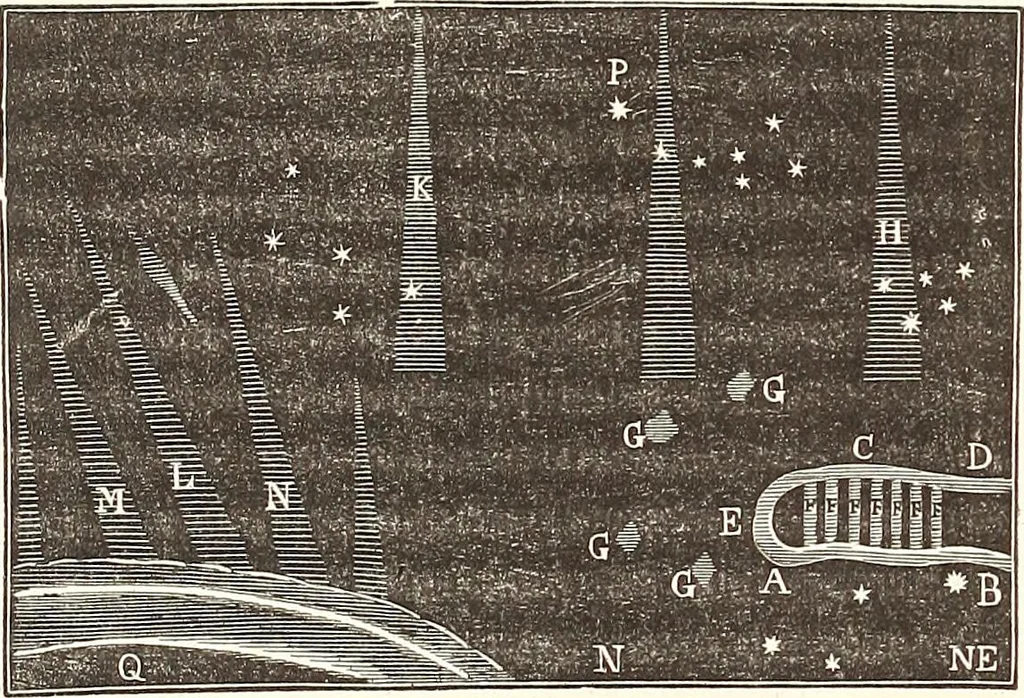
thesmall stars were visible, though so near the horizon.Above this arch were visible the rudiments ofanother and larger arch, with an interval of darksky between them. The moon rose in the courseof the night, but caused no perceptible change inthese appearances, neither diminution nor increaseof… … the appearances that have been described. A B isthe lower streak of light, somewhat brighter thanthe upper, C D. Near its lower edge appearedVega of the Harp; and the bright star in theSwans tail was below its northern extremity, (onthe left.) All that region of the heavens wasunusually black, as…
Astronomy
Internet Archive · Library of Congress · Public Domain Mark 1.0. Free to use for anything.