The wonders of the heavens, being a popular view of astronomy, including a full illustration of the mechanism of the heavens; embracing the sun, moon, and stars, with descriptions of the planets, comets, fixed stars, double stars, the constellations, the galaxy, or milky-way, the zodiacal light, aurora borealis, or norhtern lights, meteors, clouds, falling stars, aërolites, &c (1837)
Bradford, Duncan. [from old catalog] · Boston, American stationers company · leaf 392
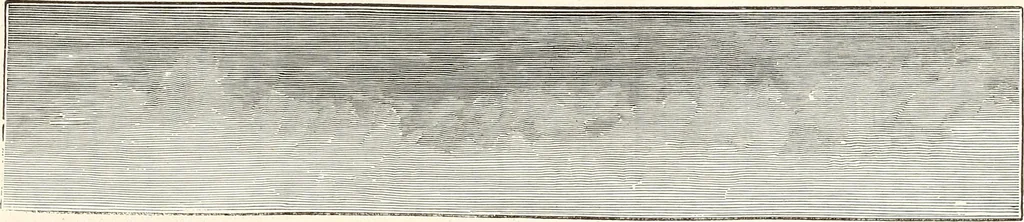
ests upon thesurface of the globe. It is of variable extent andthickness, and is called stratus, a bed or covering. It is generally formed by the subsidence of vaporin the atmosphere, and has, therefore, been de-nominated/a//-c/oM(/. This genus includes all fogs,and those creeping mists that in… … vailed through the day decrease, a white mist formsclose to the ground, or extends only for a shortdistance above it. This cloud arrives at its densityabout midnight, or between that time and morning,and it generally disappears about sunrise. It is forthis reason called by some the cloud of night.…
Astronomy
Internet Archive · Library of Congress · Public Domain Mark 1.0. Free to use for anything.