Dowling, L. Wayland (Linnaeus Wayland), b. 1867, Turneaure, F. E. (Frederick Eugene), 1866- · New York, H. Holt and company · leaf 168
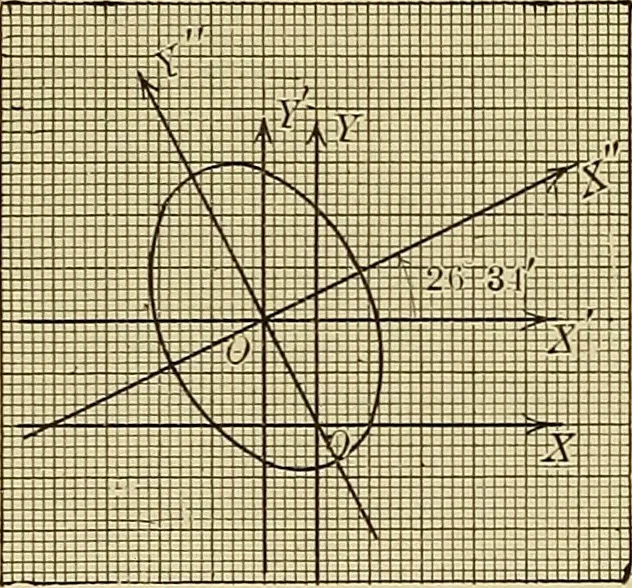
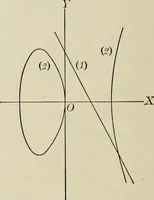
1, 2). Again, from (9),A^t. 112, t^n 2^ = 1, from which we find d = 26° 34, nearly. Hence we conclude that when theaxes are translated so that the new origin is the point (— 1, 2), the givenequation wUl take the form (3), or 8x--]-ixy + 6y^ — SG = 0, and when the axes are rotated through theangle… … 9 x2 + 4 ?/2 - 36 = 0 or - + i^ = 1.4 9 Fig. iK) The locus is therefore an ellipse whose semiaxes are 2 and 3 Figure 90shows the curve and the three sets of axes.As a second example consider the equation 2 a;2 - x?/ - 3 2/2 - 2 a: + 18 2/ - 24 = 0. Here we find A = 0 and C = - ^-f. The roots of…
Geometry, Analytic
Internet Archive · Boston College Libraries · Public Domain Mark 1.0. Free to use for anything.