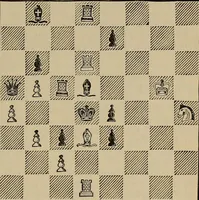
The book of chess: containing the rudiments of the game, and elementary analyses of the most popular openings (1882)
Agnel, H. R. (Hyacinth R.), 1799-1871, Staunton, Howard, 1810-1874 · New York, D. Appleton and company · leaf 69
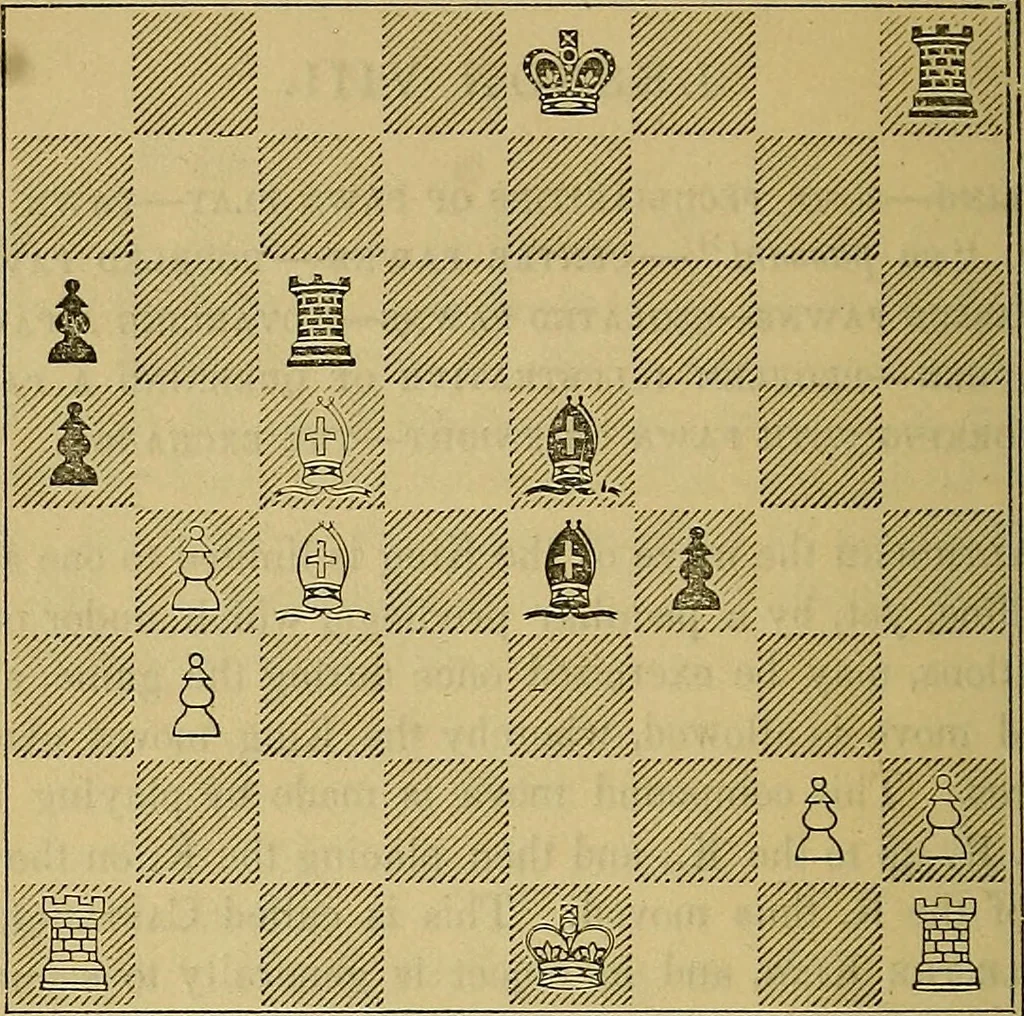
st suit his purpose. The conditions under which Castling is allowed, are asfollows:— 1. The King must not be in check. 2. The K. must nothave been moved. 3. The Rook must not have been moved.4. There must be no piece, either of your own or of youradversary, between the K. and the R. 5. The King… … In this position, supposing neither your King nor Rookshave been moved during the game, you are at liberty to cas-tle either with your K. R. or your Q. R. To castle withyour K. R., or, on your K. side, you first play your K. R. toK. B. sq., and then place your K. on K. Kt. sq.; this com-pletes the…
Chess
Internet Archive · Library of Congress · Public Domain Mark 1.0. Free to use for anything.