Higher geometry; an introduction to advanced methods in analytic geometry (1922)
Woods, Frederick S. (Frederick Shenstone), 1864- · Boston, New York, Ginn and Company · leaf 110
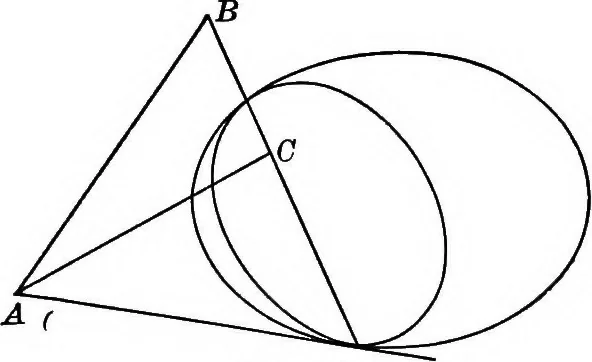
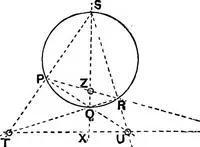
) and (2) are tangent at C and intersect in two otherpoints, as is easily proved. Theconies have no common self-polartriangle since there are not threefixed points in the collineation (9). Type III. There is a line BC(Fig. 31) each point of which isa common pole and another com-mon pole A not on… … 98 TWO-DIMENSIONAL GEOMETRY tangent to the conies. Take as B any point of BC and take C as thepole of AB. Then ABC is a common self-polar triangle. The equa-tions of the two conies may now be written as in Type I, (4) and (5),with the addition that now as= a2, in order that the collineation…
Geometry, Analytic
Internet Archive · Cornell University Library · Public Domain Mark 1.0. Free to use for anything.