Higher geometry; an introduction to advanced methods in analytic geometry (1922)
Woods, Frederick S. (Frederick Shenstone), 1864- · Boston, New York, Ginn and Company · leaf 75
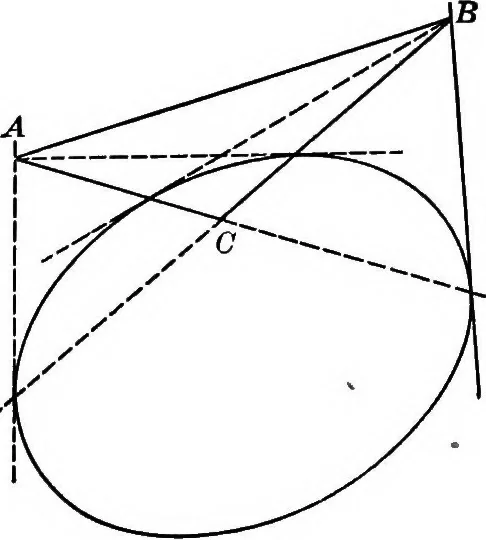
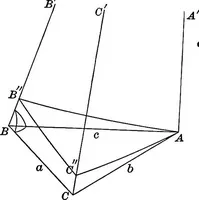
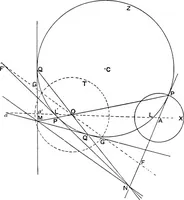
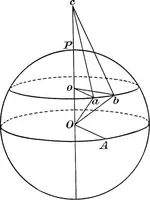
arwill pass through A (theorem V) butnot through B (theorem III). Thetwo polars now found are distinctlines (theorem I) and will intersectin a point C. Draw AB. Then AB isthe polar of C by theorem V. Thetriangle ABC is a self-polar triangle. VIII. If any straight line m is passed through a point P,… … Fig. 17 CURVES OP SECOND ORDER AND SECOND CLASS 63 Let P (Fig. 18) be any point with coordinates y{, let p be the polarof P, and let m be any line through P cutting p in Q and the curvein E and S. Then, if zt are the coordinates of Q, the coordinates ofR and S are yt+\zt and yt+\zL, where \ and \…
Geometry, Analytic
Internet Archive · Cornell University Library · Public Domain Mark 1.0. Free to use for anything.