Mechanics of engineering (solids) : comprising statics and kinetics of solids, and the mechanics of the materials of construction, or strength and elasticity of beams, columns, shafts, arches, etc. : for use in technical schools (1911)
Church, Irving P. (Irving Porter), 1851-1931 · New York : Wiley ; London : Chapman & Hall · leaf 196
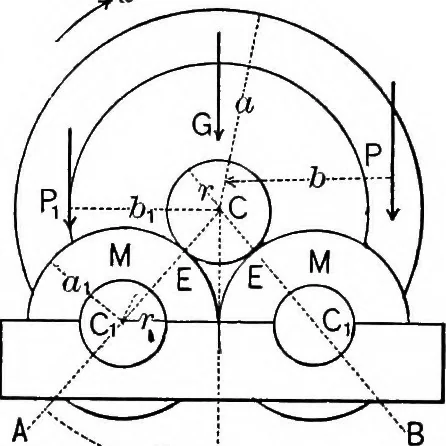
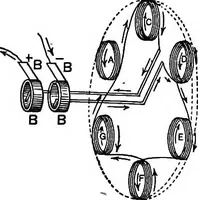
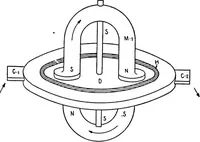
t of 800 (lbs. per sq. in.) for other metalsthan steel (Thurston), for which 1200 is sometimes allowed. With V = 200 (feet per min.) Professor Thurston found thatfor ordinary lubricants p should not exceed values rangingfrom 30 to 75 (lbs. per sq. in.). The product pv is obviously proportional to… … 167. Friction-Wheels—(Or, rather, anti-friction wheels).In Fig. 179, M and M (and two more behind) are the fric-tion-wheels, with axles Ci and d in fixed bearings. G is the weight of a heavy wheel, Pi is a known verticalresistance (tootli-pressnre), and P a.uunknown vertical working force,whose…
Mechanics, Applied · Strength of materials
Internet Archive · Cornell University Library · Public Domain Mark 1.0. Free to use for anything.