An elementary treatise on mechanics, embracing the theory of statics and dynamics, and its applications to solids and fluids (1868)
Smith, Augustus W. (Augustus William), 1802-1866 · New York : Harper · leaf 41
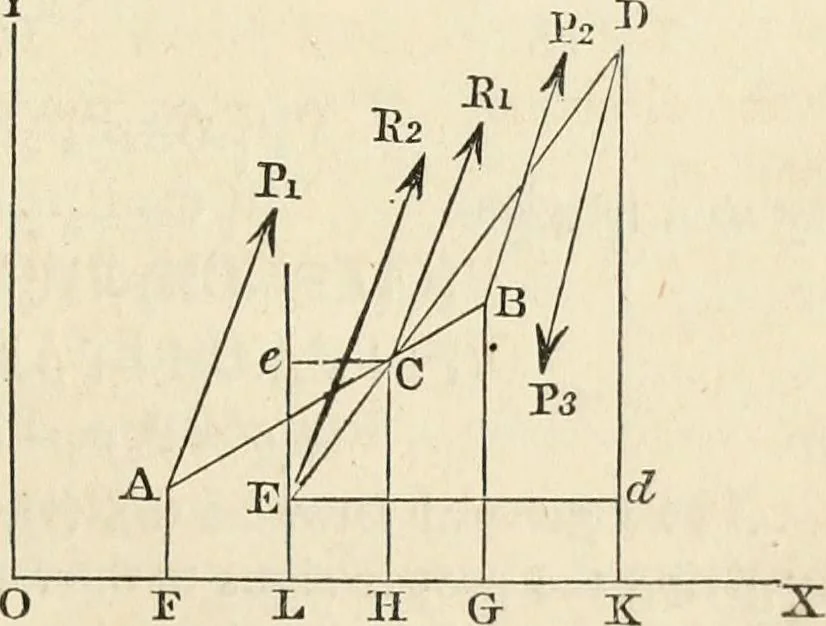
j, the resultant of yPj and P2, as found in theprevious case, be com-pounded with P3 actingat D, in a direction oppo-site to that of Pj and P2,by joining CD and pro-ducing it {Art. 40), in thedirection of the greaterforce, say R,, we haveR2, the second resultant. R2=Rj—P3, and E being its point of… … w STATICS. or (R1-P3).EL=R1.CH-P3.DK5 or R2.EL=P1.AF+P2BG-P3.DK, and so on for any other forces acting in directions opposite toP, and P2. 3°. When the point of application of either force lies in anyother angle than YOX, to its co-ordinates must be given theirappropriate sign. The ordinate y2 of…
Mechanics, Analytic
Internet Archive · California Digital Library · Public Domain Mark 1.0. Free to use for anything.