Elements of analytical geometry and of the differential and integral calculus (1866)
Davies, Charles, 1798-1876 · New York, Barnes & Co. · leaf 299
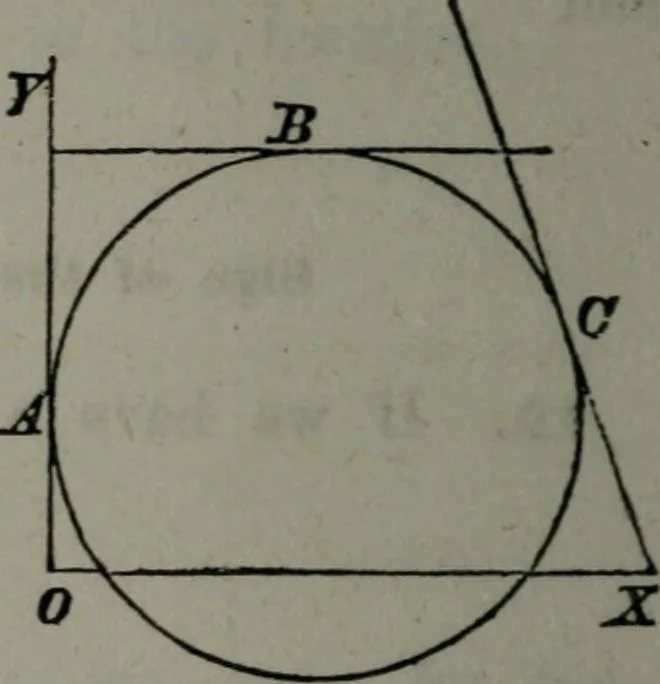
oefficient is negative. The general proposition for all the angles and everypossible relation of y and x, is this: The curve will recede from the axis of X when theordinate and first differential coefficient have the samesign^ and approach it when they have different signs. 1. To determine whether… … 2. If the tangent becomes parallel to the axis of JTat any point, as JB, -^ = tan a = 0; hence, a = 0.dx If the tangent becomes perpendicular to the axis of X^at any point, as A dydx = tan a = CO ; hence, a = 90*= SBC. IV.] SUCCESSIVE DIFFERENTIALS, 95 Eign of the second differential coefficient.…
Geometry, Analytic · Calculus
Internet Archive · California Digital Library · Public Domain Mark 1.0. Free to use for anything.