Elements of analytical geometry and the differential and integral calculus (1856)
Robinson, Horatio N. (Horatio Nelson), 1806-1867 · Cincinnati : J. Ernst · leaf 237
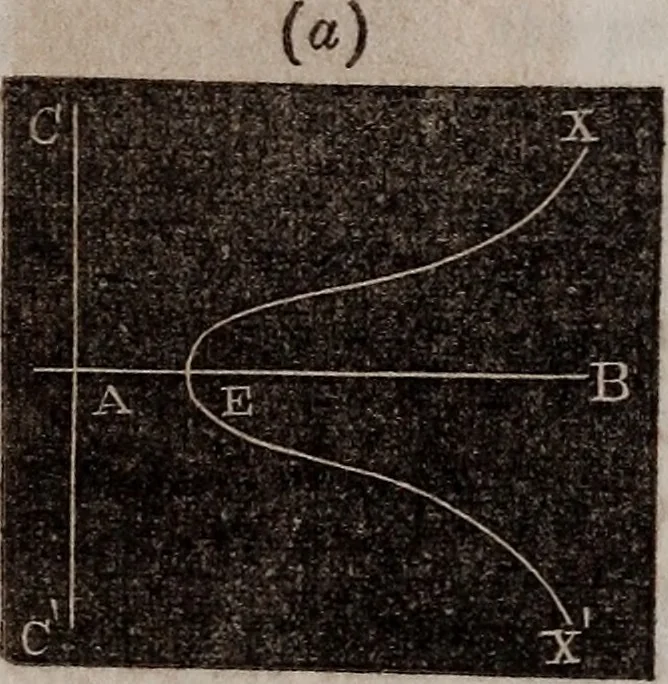
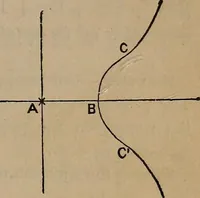
hat at that point the natural tangent with the axis ofXis 35 to radius unity, or 88° 21 49. If we make x negative in (2) while y is positive, the curvewill be concave towards the axis of X. (Art. 32.) If we make x positive in (2) while y is positive, the curve atthe corresponding point will be… … Or yz=z±?J^—b, (2) a In either (1) or (2), if we make2;=0, we shall have y=:0, thereforethe origin is a point in the curve.But on inspecting (2) it is obvious that y must be imaginaryuntil x becomes greater than h, after which there will be twobranches of the curve, as shown by the double sign,…
Geometry, Analytic · Calculus
Internet Archive · Library of Congress · Public Domain Mark 1.0. Free to use for anything.
![An illustration from Works. Popular edition.] 2 series (1886)](https://img.insideoutlibrary.com/img/200/bl-bl_003191336_9-307-1.webp)