The elements of Euclid for the use of schools and colleges; comprising the first six books and portions of the eleventh and twelfth books; (1903)
Euclid, Todhunter, I. (Isaac), 1820-1884, ed. edt, Simson, Robert, 1687-1768, ed. edt · London; New York, Macmillan · leaf 377
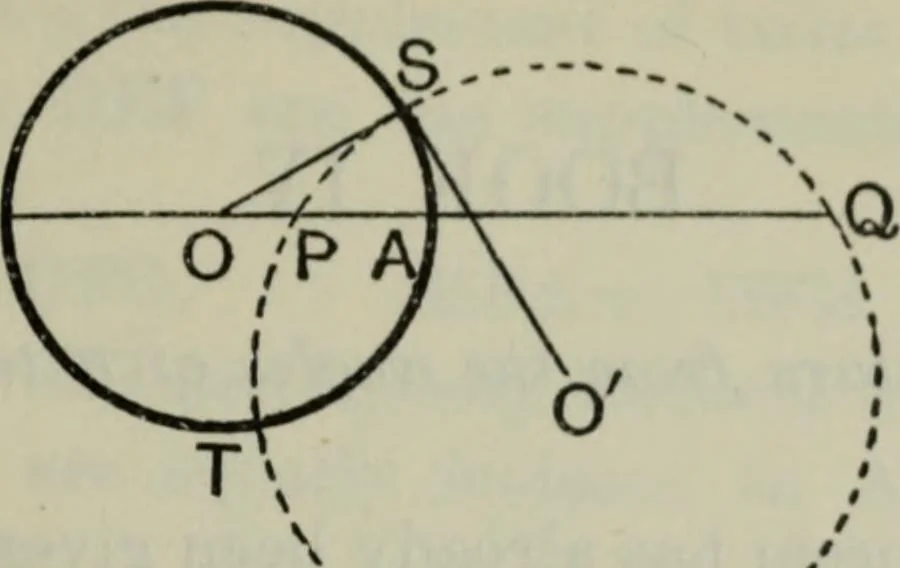
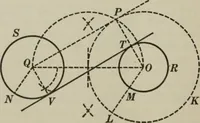
second circle is equal to the radius of the first. Either of these two conditions will determine whether tlie circles areorthogonal. It follows that if we want the circle whose centre is Og which shallcut a given circle, centre O5, orthogonally, we must take its radiusequal to the tangent from O2… … Let any such circle cut the given circle in S and T. Let 0, 0 bethe centres of the two circles and join OS, OS. Then, by hypothesis,OP.OQ-OA2 = OS2. .. OS touches the second circle at S. [HI. 37. .*. OSO is a right angle. .-. the two circles cut orthogonally at S and similarly at T. EXERCISES. ##1.…
Euclid's Elements · Geometry · Mathematics, Greek
Internet Archive · Public Domain Mark 1.0. Free to use for anything.