Elements of mechanics: treated by means of the differential and integral calculus (1887)
Peck, William G[uy], 1820-1892. [from old catalog] · New York, Chicago, A. S. Barnes & company · leaf 33
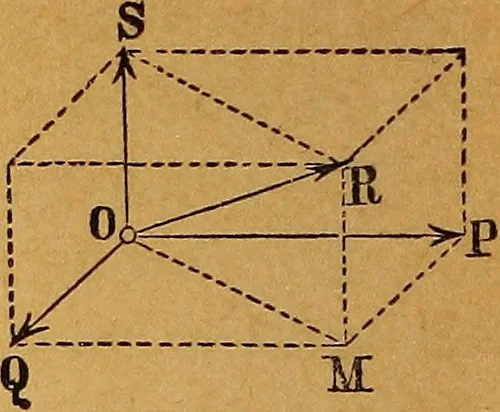
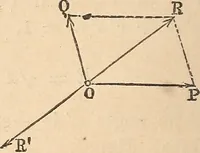
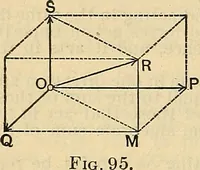
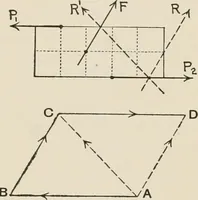
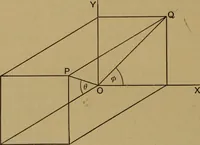
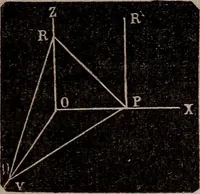
gram, their resxdtantwill be represented in direction and intensity by that diago-nal of the parallelogram which passes through their common point. This principle is called the parallelogram of pressures. Hence, we see that moving forces and pressures may becompounded and resolved according to the… … Fig. 5. as ed^cs, -construct the parallelopipedon OP, and draw OMand S±L. From the preceding article,OM represents the resultant of P andQ, and from the same article, OP rep-resents the resultant of OM and IS. Hence, OP is the resultant of thethree forces P, Q, and S. That is, ifthree forces be…
Mechanics
Internet Archive · Library of Congress · Public Domain Mark 1.0. Free to use for anything.