Elements of theoretical and descriptive astronomy, for the use of colleges and academies (1901)
White, Charles J · New York: J. Wiley & sons · leaf 120
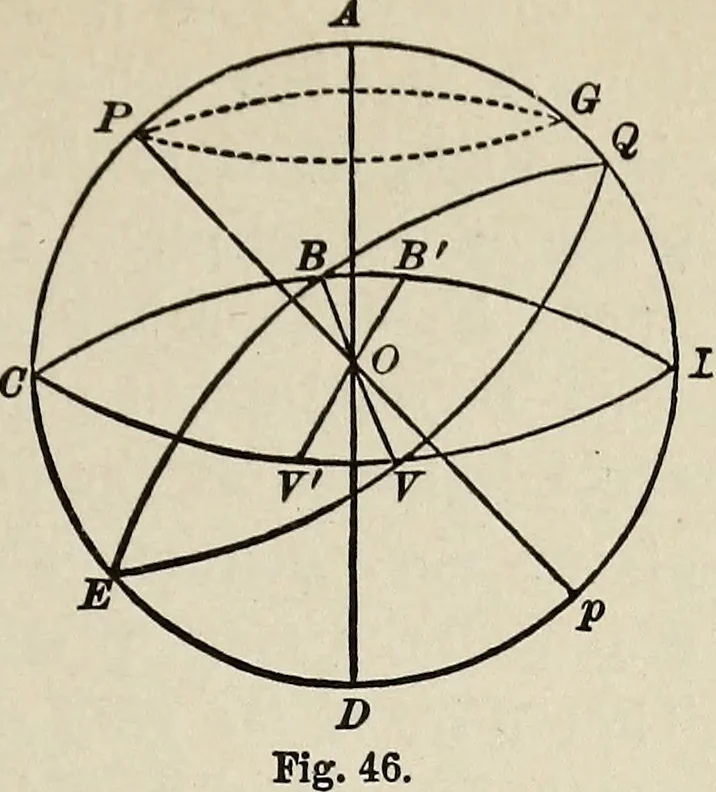
ptic remains stationary in the heavens (or at leastso nearly stationary that the latitudes of the stars only varyby half a second of arc in a year), this precession must be con-sidered to be a motion of the equinoctial on the ecliptic. In Fig. 46, let EQ represent the equinoctial, and LC the… … taiued by considering P, the pole ofthe equinoctial, to revolve about A>the pole of the ecliptic, in the circlePG (the polar radius of which, AP,is 23° 27), moving westward in thiscircle with the annual rate of 50.2,and completing its revolution in25,817 years. A general explanation of thecause…
Astronomy
Internet Archive · Public Domain Mark 1.0. Free to use for anything.