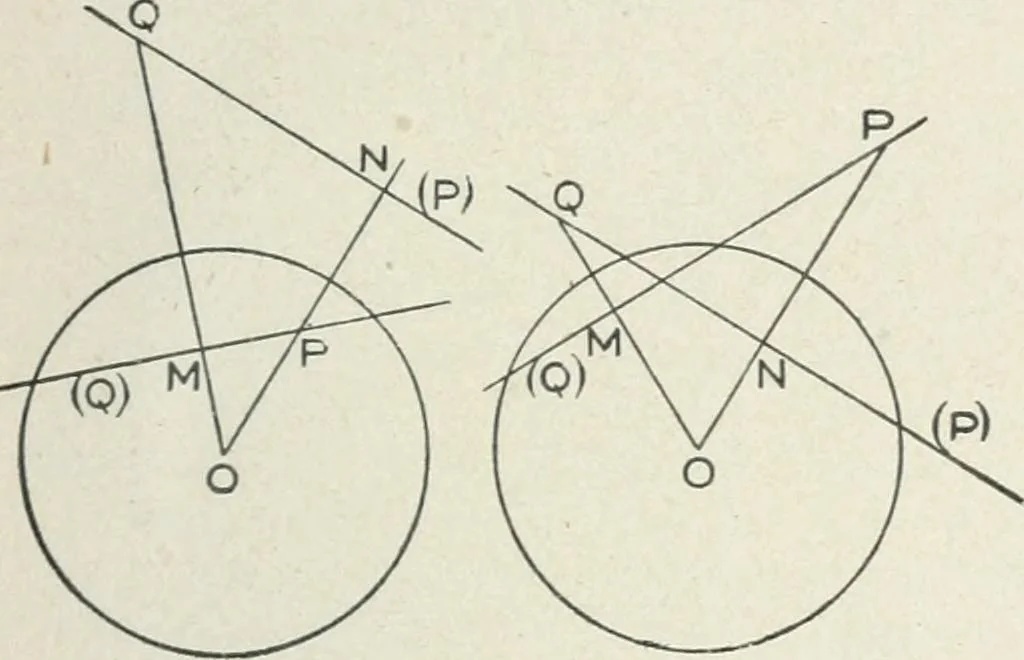
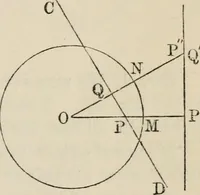
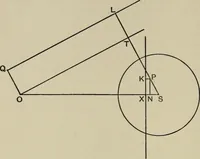
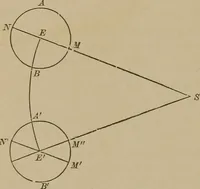
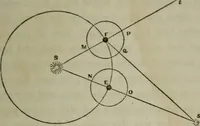
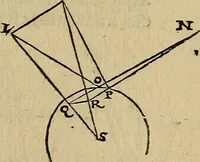
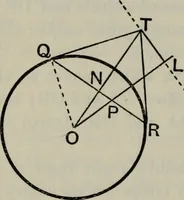
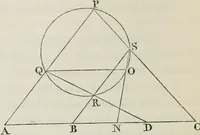
r does not cut the circle; and whenthe pole is without the circle, the polar cuts the circle. The polar of P may conveniently be denoted byenclosing P in brackets,—(P). Since the polar is at right angles to the line join-ing the centre to the pole, therefore the angle sub- Additional Propositions.… … Let (P) be polar of p, and let Q be any point on (P). Then the polar of Q passes through p. Join OQ, and draw PM perpendicular to OQ. Thenthe angles at M aiid N being right angles, a circlemay be described to pass through the points p, M, Q, N.Therefore OQ . OM = OP . ON = (radius) 2. Hence PM is…
Geometry · Geometry, Plane
Internet Archive · Western University Libraries · Public Domain Mark 1.0. Free to use for anything.