Manufacture of narrow woven fabrics, ribbons, trimmings, edgings, etc., giving description of the various yarns used. The construction of weaves and novelties in fabric structures, also descriptive matter as to looms, etc (1917)
Posselt, E. A. (Emanuel Anthony), 1858-1921 · Philadelphia, Textile Pub. Co · leaf 67
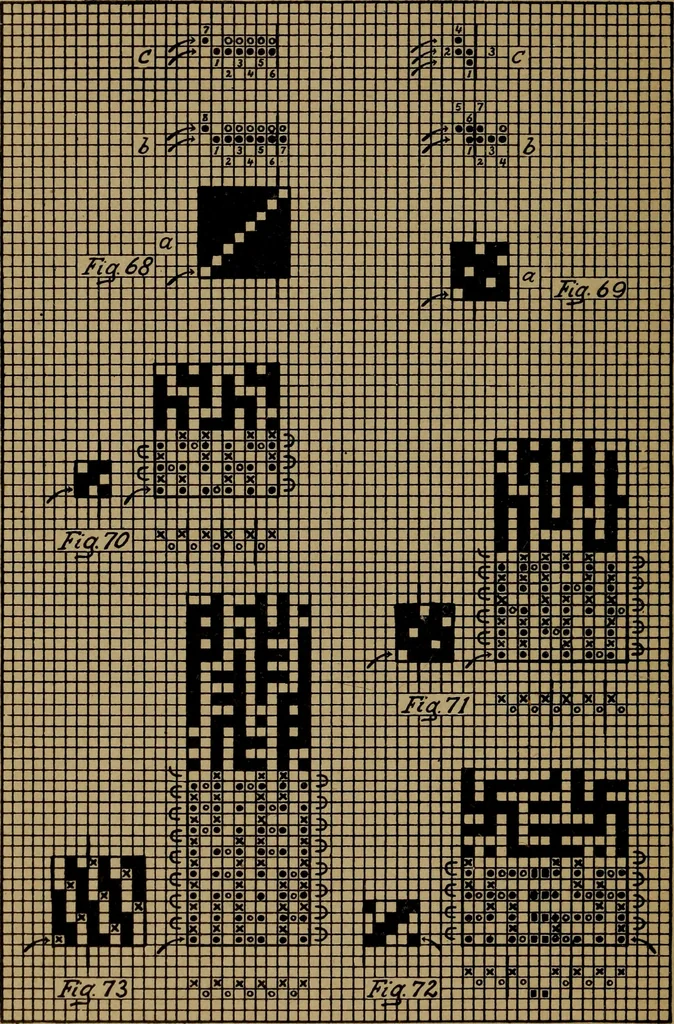
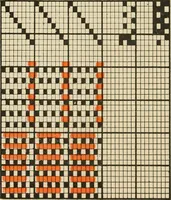
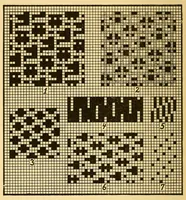
terlacing of thisweave is 4 up 1 down. Considering the entering ofthe filling to be done from the left, we then find ifreading from the first to the second sinker, 7 risers inthe place of 4 (see Fig. 69^). For this reason, wethen have to cross off three warp threads from therepeat of the weave,… … The most often used arrangement of face and backis 1: 1, although others may be called upon. Derivative Weaves. 55 Fig. 70 is a hollow-cord weave interlacing withthe 3-harness twill. The foundation number is 2.The design shows three repeats of the single weaveplus the foundation number (3X3 + 2=11…
Weaving · Textile fabrics
Internet Archive · Smithsonian Libraries · Public Domain Mark 1.0. Free to use for anything.