Mechanical movements, powers and devices; a treatise describing mechanical movements and devices used in constructive and operative machinery and the mechanical arts, being practically a mechanical dictionary, commencing with a rudimentary description of the early known mechanical powers and detailing the various motions, appliances and inventions used in the mechanical arts to the present time, including a chapter on straight line movements, by Gardner D. Hiscox (1914)
Hiscox, Gardner Dexter, 1822?-1908 · New York, The Norman W. Henley publishing co. · leaf 36
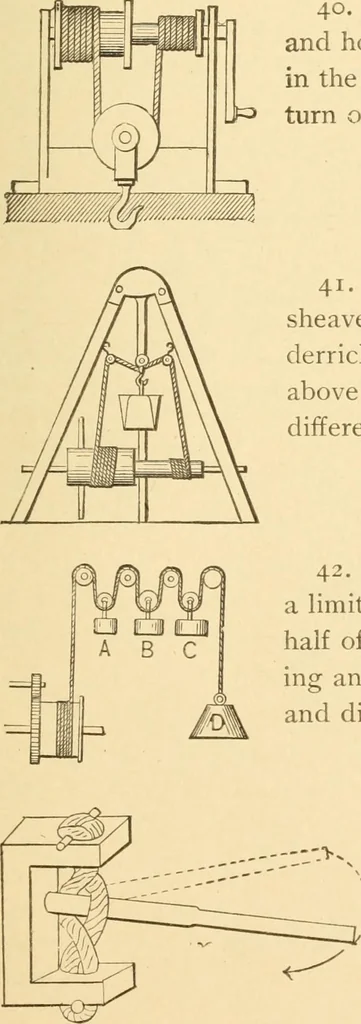
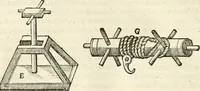
39. Roving of a two and three sheave pair ofblocks, with end of rope fixed to lower block. m W = P X 5. … 40. CHINESE WINDLASS.—The sheave and hook rises equal to one-half the difference in the circumference of the barrels for each }^ turn of the crank. See No. 27 for the power. 41. CHINESE SHAFT DERRICK.—The sheaves suspended from the upper part of thederrick legs allows the bucket to be raisedabove…
Mechanical movements
Internet Archive · Library of Congress · Public Domain Mark 1.0. Free to use for anything.