Maurer, Edward R. (Edward Rose), b. 1869 · New York : John Wiley & sons, inc.; [etc., etc.] · leaf 88
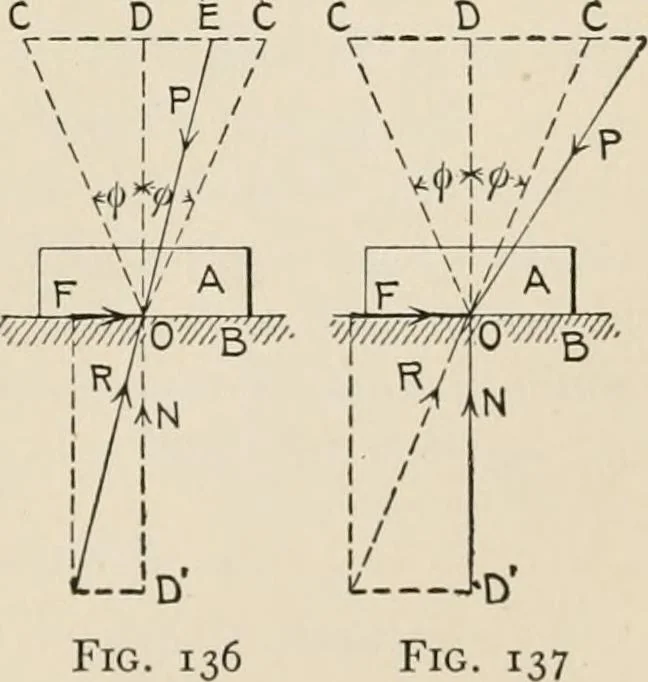
iction.If the line of action of the resultant P doesnot fall outside the cone (Fig. 136), then thereis no slipping; if it does fall outside (Fig. 137),then there is slipping. Proof follows: Asalready pointed out, the direction of the total reaction i? on a body, whichtends to slide over another,… … ^o Chap, iv obtains when slipping impends. Therefore when P acts within the cone oralong an element of it, then R can incline and completely oppose P (Fig. 136),no matter how large P may be. When P falls outside the cone, R can inclineonly to an element, and the friction cannot successfully oppose…
Mechanics
Internet Archive · California Digital Library · Public Domain Mark 1.0. Free to use for anything.