Newton's Principia, sections I, II, III, with notes and illustrations. Also a collection of problems (1863)
Newton, Isaac, Sir, 1642-1727, Frost, Percival, 1817-1898 · Cambridge, London, Macmillan and Co · leaf 218
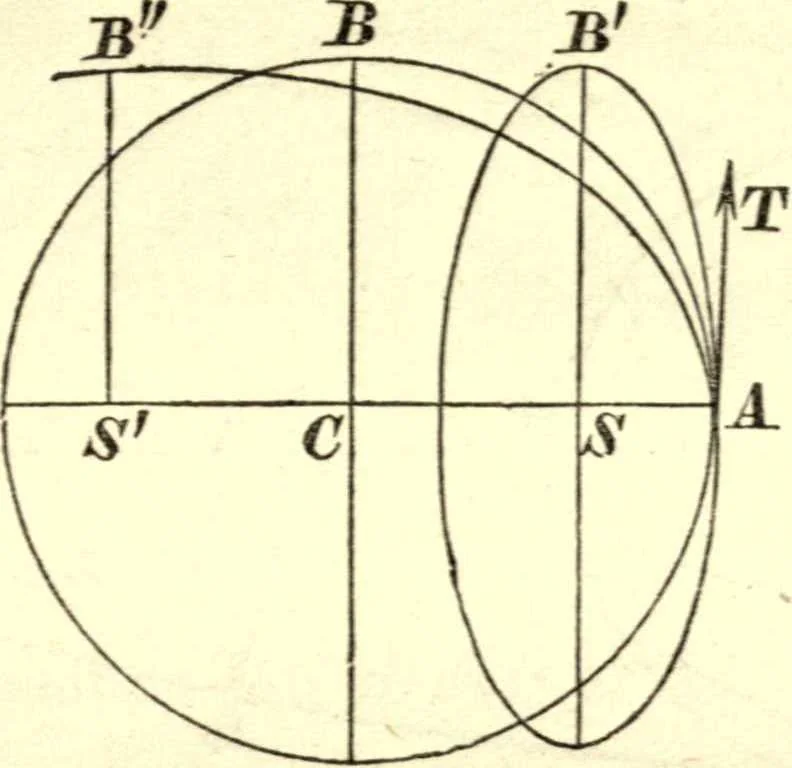
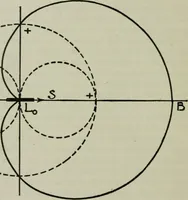
distance and is attractive,the orbit will be an ellipse. (2) And, since the force is a finite force, the body will movein the same direction as before, at the moment of the change. (3) Also, the velocity will, for the same reason, be unaltered, at that moment, since the force requires a finite time… … Then F2 = /*. CA . CA = //,. CA2; and if S, the new point towhich the force tends, be in CA, let AS be the ellipse described,by (1); SA is one of the semiaxes of the ellipse, since A is anapse, by (2), and, SB being the other, if a body revolved in thisellipse round S, //-. SB2 would be the square…
Mechanics · Celestial mechanics
Internet Archive · California Digital Library · Public Domain Mark 1.0. Free to use for anything.