Plane and solid analytic geometry; an elementary textbook (1901)
Ashton, Charles H. (Charles Hamilton), 1866- · New York, C. Scribner's sons · leaf 217
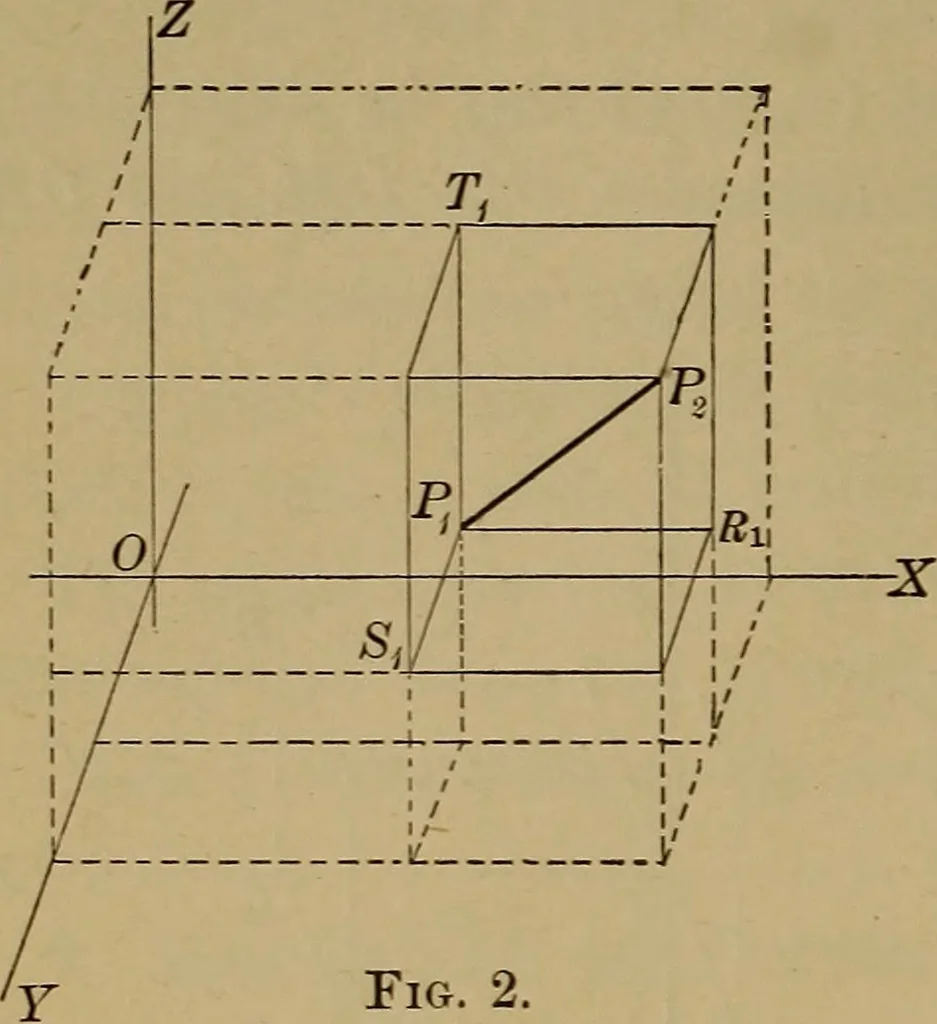
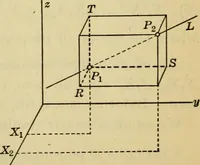
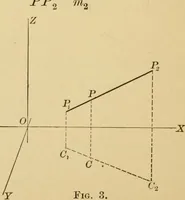
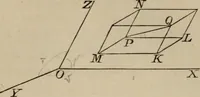
3, 4. 1), (- 3, - 1, 2), (2, - 3, 1), (1, 1, - 2),(-1, 4, -2), (-3, -2, -1), (4, -1, -2); (3, 4, 0),(-2, 0, 1), (0, -i, 3); (5, 0, 0), (0, 3, 0), (0, 0, -2). 3. Distance between two points. — Let Px and P2 be any two points in space, and through each of thempass three planes parallel to the… … pxpf = pjtf + pa Eig. 2 But P1B1 = x2 — xv and P\TX = z2 — zv Hence PXP2 = Vte - a>i)2 + (2/2 - 2/1)2 + (»2 - zi)2. [1]The distance, p, of any point from the origin is p = V«2 + y2 + s2. [2] evidently 4. To divide a line in any given ratio. — Let the pointP divide the line PXP2 so that P,P…
Geometry, Analytic
Internet Archive · Library of Congress · Public Domain Mark 1.0. Free to use for anything.