Bailey, Frederick H. (Frederick Harold), 1865- · Boston, London, Ginn & Co. · leaf 27
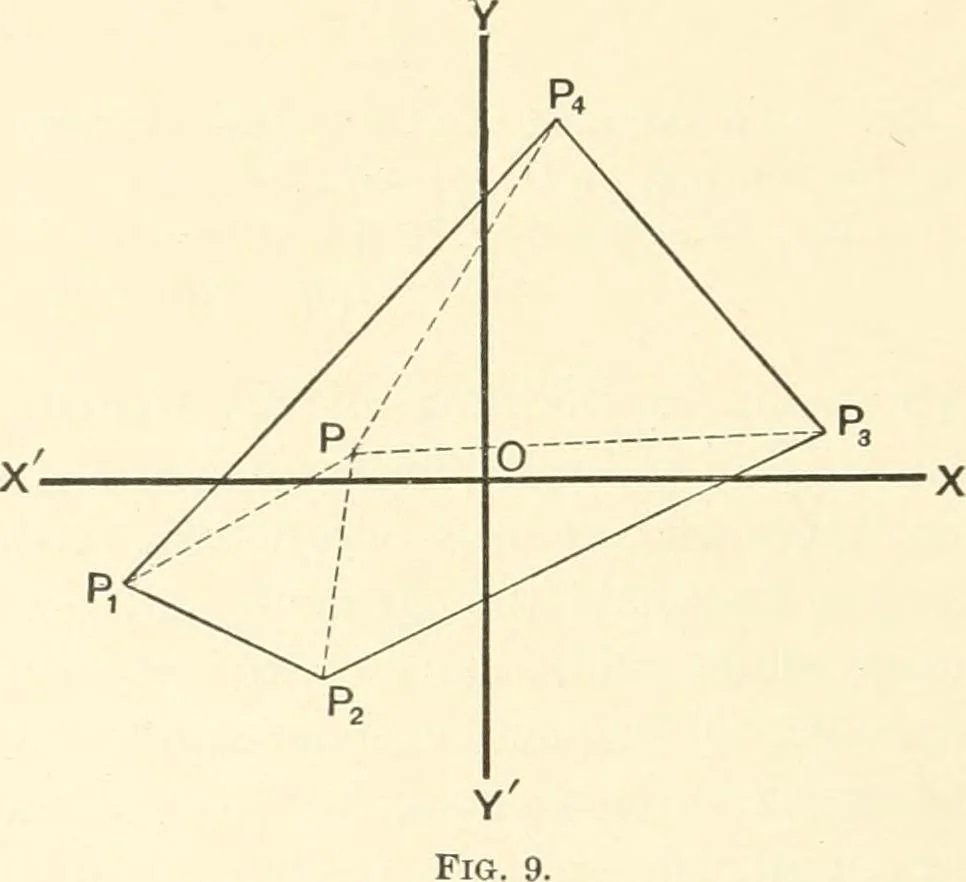
by diagonals, andtaking the sum of the areas of the triangles thus formed. 12 PLANE ANALYTIC GEOMETRY. But we can deduce a formula for the area of any polygon,exactly similar to that for the area of a triangle, and givingthe same working rule. This causes a great saving oftime over the method first… … Let P (x, y) be any point within the quadrilateral, and drawthe lines PPi, PPg, PP3, and PP4, forming the triangles PP1P2,PP2P3, PP3P4, and PP^Pi. By [6] §5, Area of PPiPo = i{xyi — Xjy + Xiy, —xsyi + x.y — xyz}, • PP2P3 = |{xy2 —x.2y + x2y3 —X3y2+X3y —xys}, PP3P4 = i{xy3 —xsy + xgyi—X4y3+X4y…
Geometry, Analytic
Internet Archive · California Digital Library · Public Domain Mark 1.0. Free to use for anything.