Osgood, William F. (William Fogg), 1864-1943, Graustein, William C. (William Caspar), 1888-1941, joint author · New York : The Macmillan Company · leaf 189
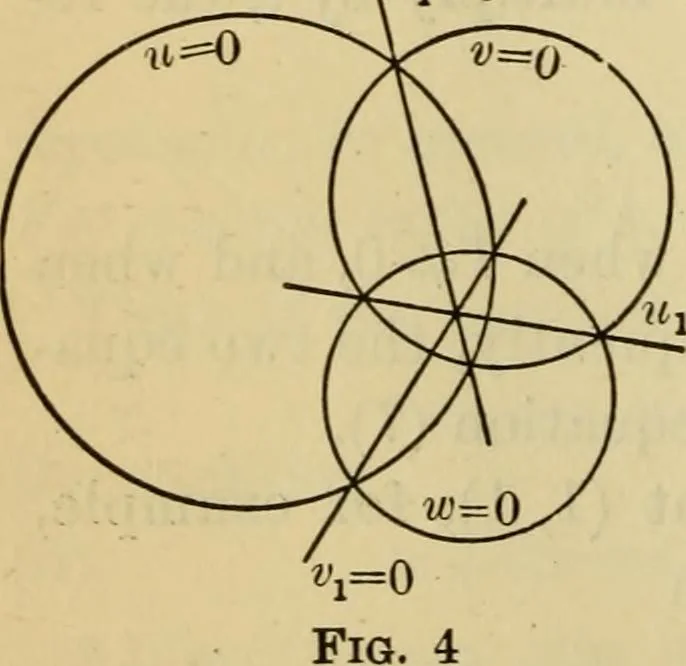
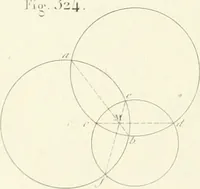
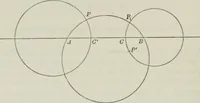
{a-a)x+{h-h)y+{c-c)=0 represents a curve which passes through the two points of intersection of the circles. But this equation, being linear, represents a straight line, and is, therefore, the equation of the common chord of the circles. The foregoing proof is open to the criticism that conceivably… … «i=0 Example 2. We can now provethe following theorem : Given threecircles, each pair of which intersect.Then their three common chordspass through a point, or are parallel. Let two of the three given circlesbe those of Example 1, and let theequation of the third circle be w = x^-\-y^ + ax + by + c…