Osgood, William F. (William Fogg), 1864-1943, Graustein, William C. (William Caspar), 1888-1941, joint author · New York : The Macmillan Company · leaf 316
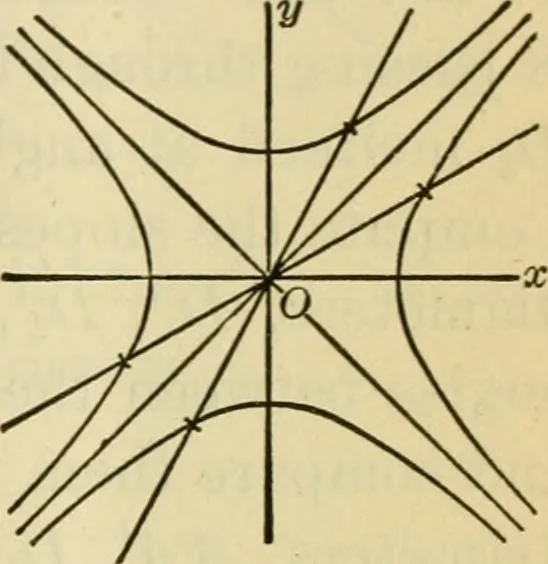
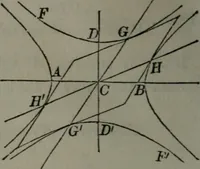
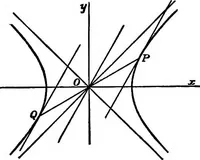
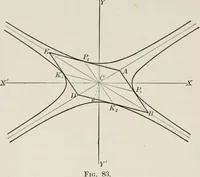
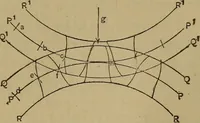
perpen-dicular, is the circle. There is no specialhyperbola with this property, since twoconjugate diameters of a hyperbola, otherthan the axes, always pass through thesame quadrants. For this reason, too,there are no conjugate diameters equallyinclined to the axes. There may, however, be conjugate… … Fig. 7 a2 or 0? = &2, that is, only if the hyperbola is rectangular. In this caseXA = 1, and every pair of conjugate diameters are in the re-quired relation. Consequently, the two diameters are equallyinclined to the asymptotes, inasmuch as the asymptotes arenow the bisectors of the angles…