The practical draughtsman's book of industrial design and machinist's and engineer's companion : forming a complete course of mechanical, engineering and architectural drawing (1866)
Armengaud, M. (Jacques Eugène), 1810-1891, Armengaud, M. (Charles), 1813-1893, Amouroux, M. (Jules), Johnson, William, 1823-1846 · Philadelphia : H.C. Baird · leaf 27
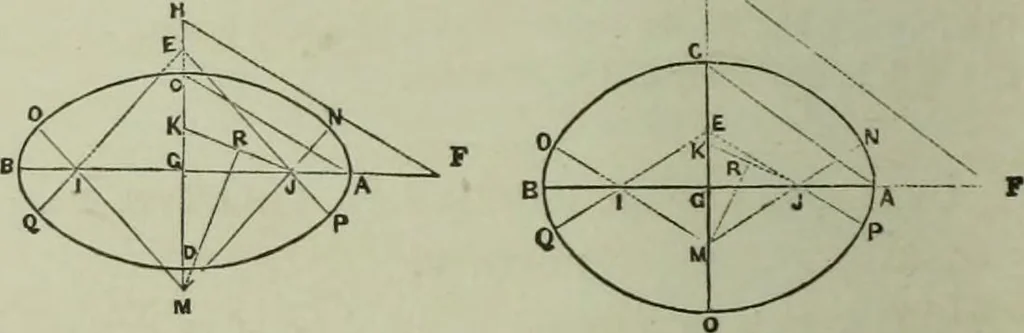
one—whether crescendo or diminuendo—the greater will be thedifference of the result from the true one. From this it follows,that if a rule applies not to all, it can only apply to one propor-tion ; and also, that if it apply to a certain proportion and not toanother, it can only be correct in that… … Set off b i, a j, and c k, equal to H c; join j k, and bisect it in R,and at k erect a perpendicular, cutting c d, or c d produced, at m ;then make g e equal to g m ; j, e, i, m, will be the centres of thefour circles required. Through the points, j and i, draw m n, m oe p, e q, each equal to m c ;…