Addyman, Frank Thornton · London : Scott, Greenwood & co. · leaf 67
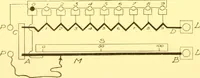
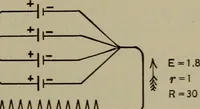
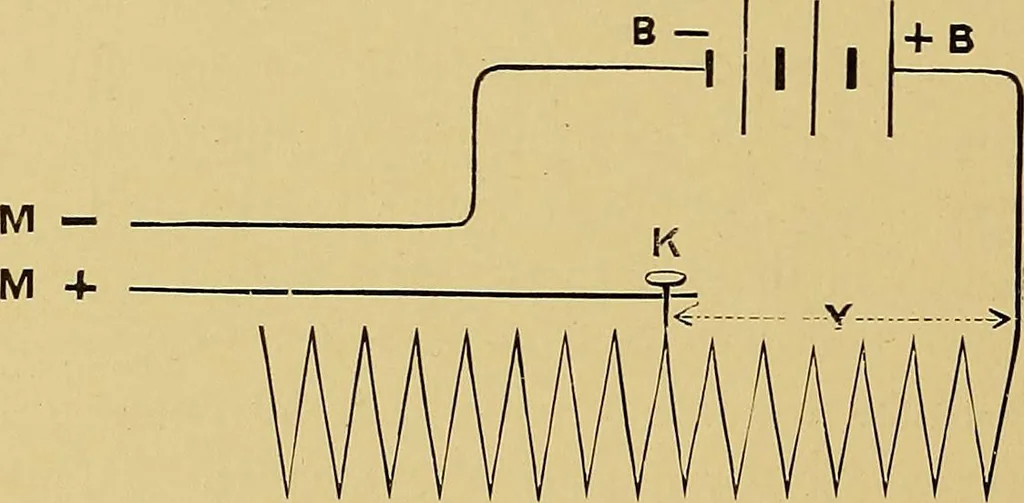
ntialbetween the point M + and the point M - will be 200 volts.Acting against this pressure is the battery whose electro-motiveforce we may consider to be 12 volts. If now we take anysection of the circuit connecting M + and M -, the fall ofpotential in that section, i.e., the electro-motive force… … Fig. 11.—Diagram showing Action of a Rheostat. electro-motive force between the ends of r will be ^ of 200volts, or 180 volts, and that acting on the battery tl of 200volts, or 20 volts, which is sufficient to overcome the opposingforce and to charge up the accumulator. In practice therheostat is…
X-rays
Internet Archive · Medical Heritage Library · Public Domain Mark 1.0. Free to use for anything.
![An illustration from [Electric engineering.] (1902)](https://img.insideoutlibrary.com/img/200/ia-electricengineer01inte-499-204.webp)