Science and art drawing : complete geometrical course ; consisting of plane and solid geometry, orthographic and isometric projection, projection of shadow's the principles of map projection, graphic arithmetic and graphic statics (1895)
Spanton, J. Humphrey (John Humphrey) · London : Macmillan · leaf 583
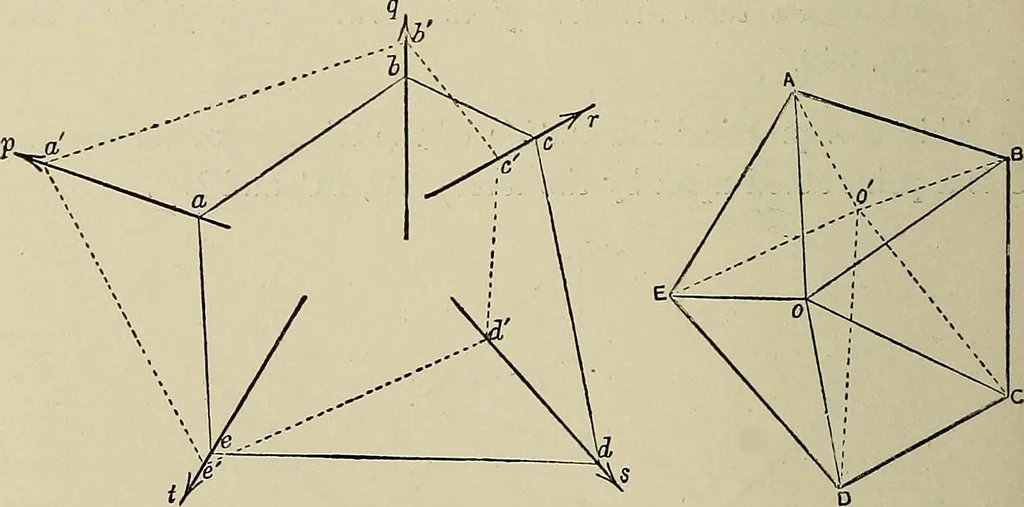
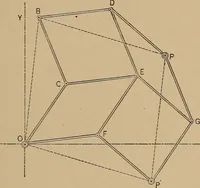
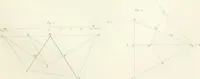
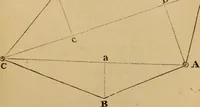
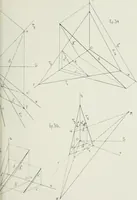
= the weights Q and E, anddo and co the tension on the lines DE and EB. The Funicular Polygon.—When a series of forces in the sameplane do not act at the same point, but so as to stretch anendless cord at different points, the polygon formed by the cordthen in equilibrium is called the funicular… … Fig. 350. EC to q; CD to r; DE to s ; and EA to t. Assume any point0 in this polygon,—this is called the pole,—and join each of theangles of the polygon to it. These lines are called vectors. Commencing at any point a on the line of the force p, drawah parallel to the vector oB; he to oC ; cd to…
Geometrical drawing
Internet Archive · Wellesley College Library · Public Domain Mark 1.0. Free to use for anything.