A text book of elementary mechanics, for the use of colleges and schools (1881)
Dana, Edward Salisbury, 1849-1935 · New York, J. Wiley & sons · leaf 183
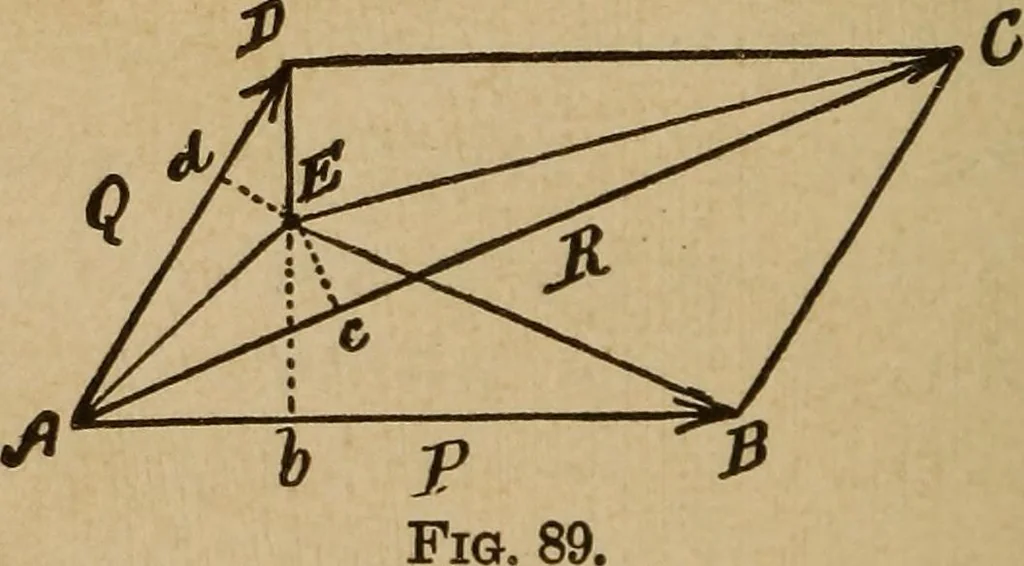
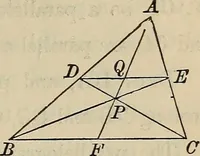
angle—that is, the perpendicular from E on AB—is equal to the sum of the altitudes of the other tri-angles; that is, the perpendiculars on the line DC fromthe vertices E and A. Hence triangle ABE — triangle ADC + triangle EDC, = triangle AEC — triangle ADE; • \ triangle ABE+ triangle ADE = triangle… … opposite kinds. The triangle AEB is equal to thedifference of the triangles ADC, EDC, for they haveequal bases AB and DC, and the altitude of the firsttriangle (the perpendicular from E on AB) is equalto the difference of the altitudes of the others (the per-pendiculars from A and E on DC). Hence…
Mechanics
Internet Archive · Library of Congress · Public Domain Mark 1.0. Free to use for anything.