Textile raw materials and their conversion into yarns : (the study of the raw materials and the technology of the spinning process) a text-book for textile, trade and higher technical schools, as also for self-instruction ; based upon the ordinary syllabus and curriculum of the Imperial and Royal Austrian weaving schools (1901)
Zipser, Julius, Salter, Charles · London : Scott, Greenwood · leaf 360
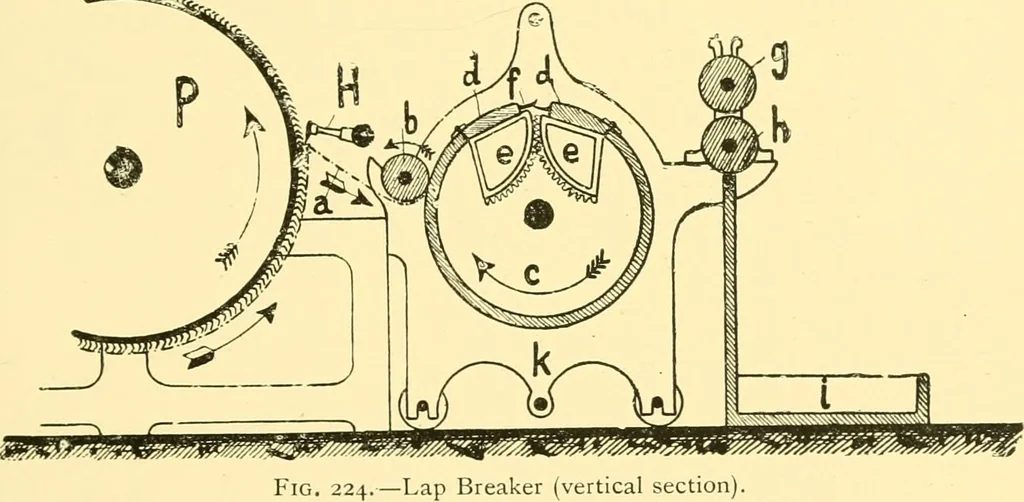
s, when sufificient thickness has been obtained, broken in adirection parallel to the axis of the roller, and is then deliveredto the next machine of the series, namely, the intermediatecard. The lap is laid on the feed creeper in such a mannerthat the fibres run almost parallel to the longitudinal… … rougher, but the constituents are more thoroughly mixed.Consequently, in working up mixtures of wool and woolsubstitutes, cross feed is always employed. To render the work independent of the care of the millhand a lap breaker has been introduced, i.e., a device forautomatically tearing apart the…
Textile fibers · Spinning
Internet Archive · UMass Dartmouth, Claire T. Carney Library · Public Domain Mark 1.0. Free to use for anything.