The wonders of the heavens, being a popular view of astronomy, including a full illustration of the mechanism of the heavens; embracing the sun, moon, and stars, with descriptions of the planets, comets, fixed stars, double stars, the constellations, the galaxy, or milky-way, the zodiacal light, aurora borealis, or norhtern lights, meteors, clouds, falling stars, aërolites, &c (1837)
Bradford, Duncan. [from old catalog] · Boston, American stationers company · leaf 137
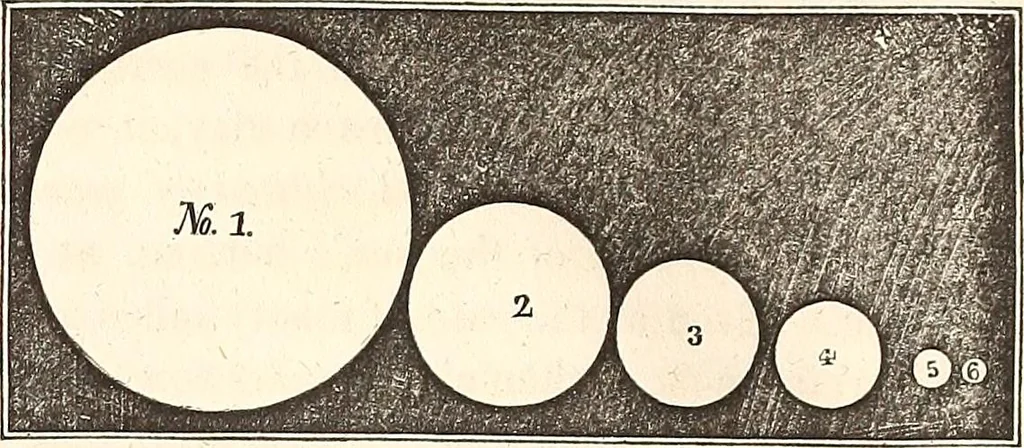
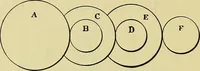
t seem-ed largest, he could determine that all the planetsmoved in orbits of which the sun is not exactly atthe centre. As the planets are at very different distancesfrom the sun, the apparent disc of that luminarywill vary in magnitude at the ^different planets.Suppose No. 1 to represent the size… … Jupiter; No. 6 at Saturn. At Herschel it wouldbe represented by a circle one half as large asNo. 6 ; Herschel being twice as far from the sunas Saturn. The sun is the grand source of light and heat,both to the earth and to all the other planetarybodies. The heat he diffuses animates every partof…
Astronomy
Internet Archive · Library of Congress · Public Domain Mark 1.0. Free to use for anything.