The wonders of the heavens, being a popular view of astronomy, including a full illustration of the mechanism of the heavens; embracing the sun, moon, and stars, with descriptions of the planets, comets, fixed stars, double stars, the constellations, the galaxy, or milky-way, the zodiacal light, aurora borealis, or norhtern lights, meteors, clouds, falling stars, aërolites, &c (1837)
Bradford, Duncan. [from old catalog] · Boston, American stationers company · leaf 22
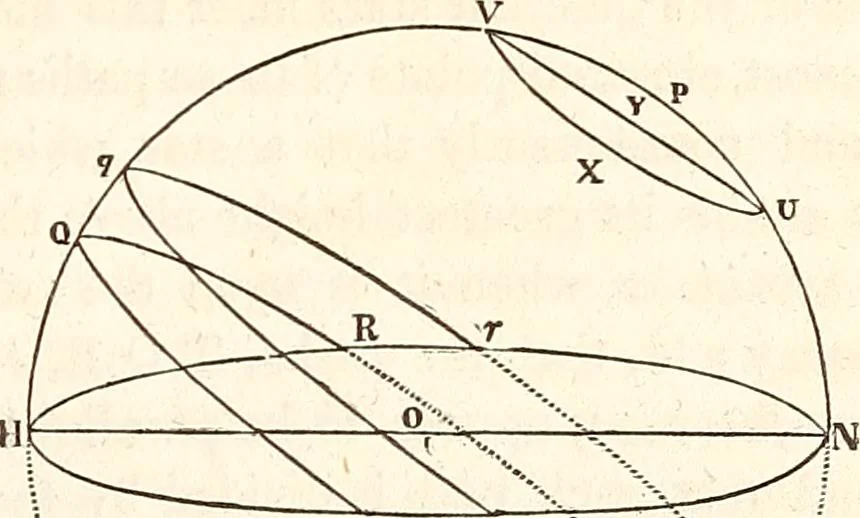
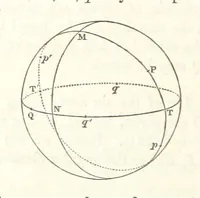
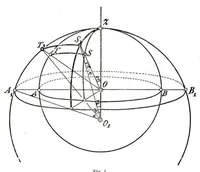
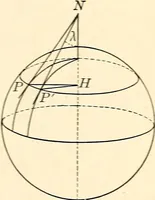
,minutes and seconds will not be of the same abso-lute length as those of the great circles; therefore,to compare the results, we must first determine thevalue of a degree on each parallel as comparedwith that of a great circle. That the motion of thestars is constantly uniform, that it is exactly… … T ... t p- hemisphere H Q, j N,) being his position. Let Tbe the spot where a star first rises, T Q, R its pathabove the horizon, and R the point where it sets;and let the arc T H R of the horizon, interceptedin one direction between the points T, R, be bi-sected in the point H, and the arc T N R,…
Astronomy
Internet Archive · Library of Congress · Public Domain Mark 1.0. Free to use for anything.