The wonders of the heavens, being a popular view of astronomy, including a full illustration of the mechanism of the heavens; embracing the sun, moon, and stars, with descriptions of the planets, comets, fixed stars, double stars, the constellations, the galaxy, or milky-way, the zodiacal light, aurora borealis, or norhtern lights, meteors, clouds, falling stars, aërolites, &c (1837)
Bradford, Duncan. [from old catalog] · Boston, American stationers company · leaf 308
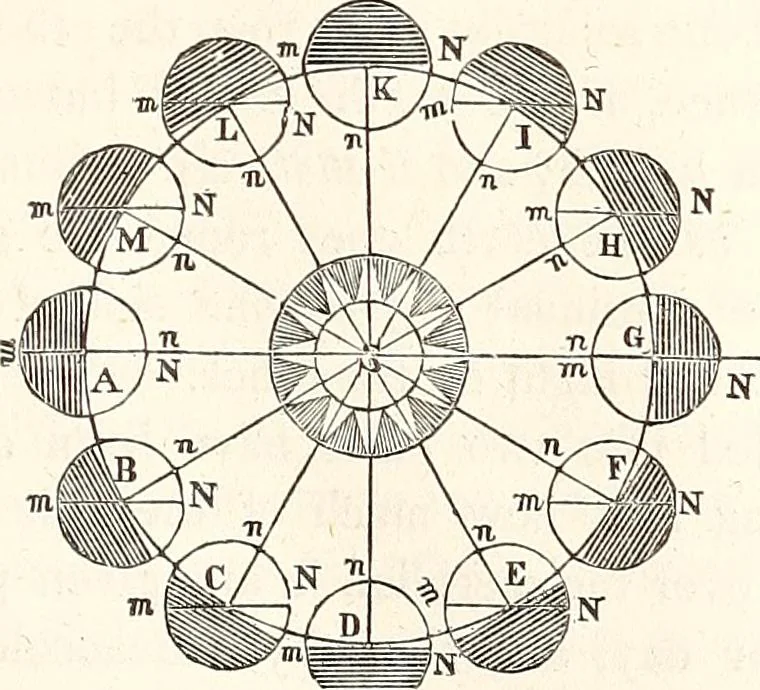
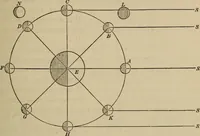
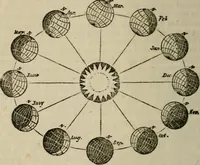
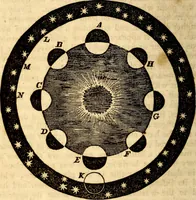
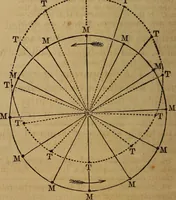
by Julius Csesar—Per-sian calendar—Subdivisions of the year—Cycle—Dionysian period—Dominical letters—Julian period. The fixed stars appear to go round the earth intwenty-three hours, fifty-six minutes, and fourseconds, and the sun in twenty-four hours, so thatthe stars gain three minutes and… … three hundred and sixty-six days as measured bythe stars returning to it. The former are calledsolar days, and the latter sidereal. The diameter of the earths orbit is but a physi-cal point in proportion to the distance of the stars.For this reason, and the earths uniform motionon its axis, a given…
Astronomy
Internet Archive · Library of Congress · Public Domain Mark 1.0. Free to use for anything.