The wonders of the heavens, being a popular view of astronomy, including a full illustration of the mechanism of the heavens; embracing the sun, moon, and stars, with descriptions of the planets, comets, fixed stars, double stars, the constellations, the galaxy, or milky-way, the zodiacal light, aurora borealis, or norhtern lights, meteors, clouds, falling stars, aërolites, &c (1837)
Bradford, Duncan. [from old catalog] · Boston, American stationers company · leaf 347
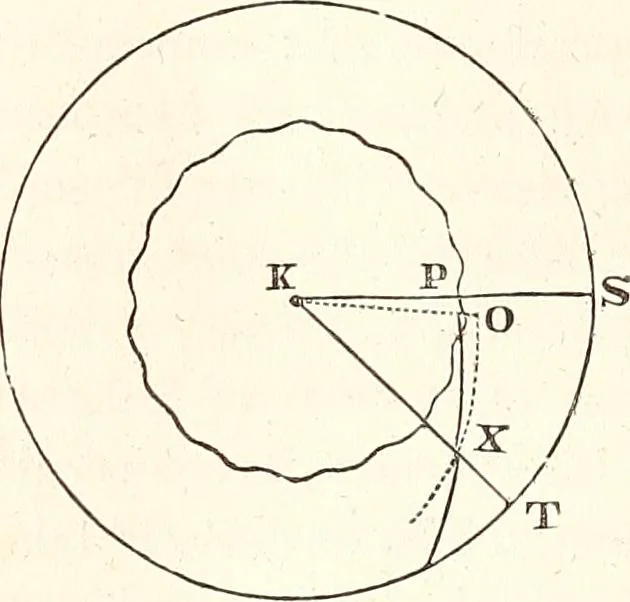
f a periodical cause of fluctuation, and presentinga result, not as it was observed, but as it wouldhave been observed had that cause of fluctuationhad no existence. For these purposes, in the present case, veryconvenient formulae have been derived, and tablesconstructed; but they are of too… … In the triangle K P X, K P is the obliquity of theecliptic, K X the co-latitude, or complement of lati-tude, and the angle PKX the co-longitude of theobject X. These are the data of our question, ofwhich the first is constant, and the two latter arevaried by the effect of precession and nutation;…
Astronomy
Internet Archive · Library of Congress · Public Domain Mark 1.0. Free to use for anything.