Aristarchus of Samos, the ancient Copernicus; a history of Greek astronomy to Aristarchus, together with Aristarchus's Treatise on the sizes and distances of the sun and moon (1913)
Heath, Thomas Little, Sir, 1861-1940, Aristarchus, of Samos. On the sizes and distances of the sun and moon. English & Greek. 1913 · Oxford : Clarendon press · leaf 278
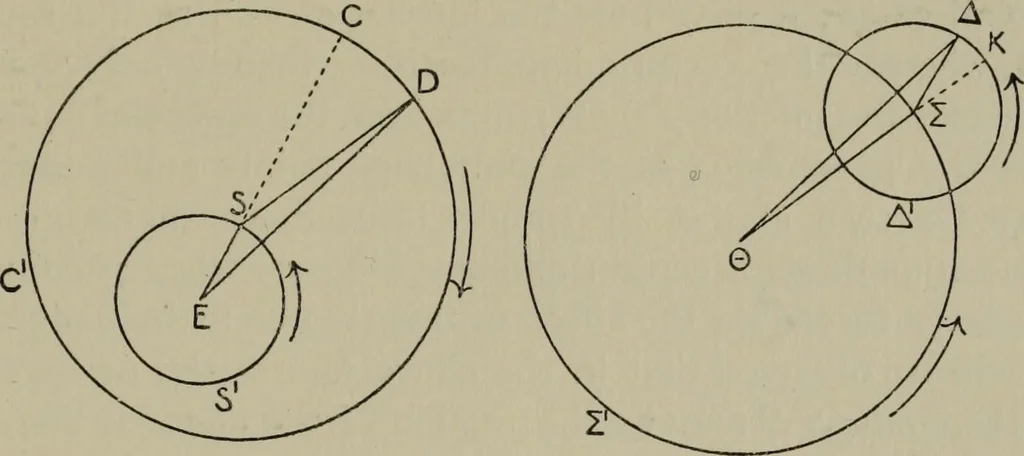
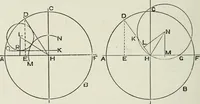
ill be seenfrom the earth in the direction ED. Now [Fig. 13 (b)], on the hypothesis of the epicycle, let Θ be thecentre of the earth. About Θ as centre describe the circle X5 equalto the eccentric circle of the other figure, and draw the radius Θ^parallel (and equal) to SD in the other figure. Take… … (A) (B) Fig. 13. ΚϋΔ equal to the anomaly (i. e. the angle CSD in the other figure)but reckoned in the opposite sense (i.e. in the direct order of thesigns). Suppose then that the planet is at Δ and seen from theearth in the direction θ J. In the triangles ESD, Θ2Δ, DS is equal and parallel to…
Aristarchus, of Samos · Astronomy, Greek · Astronomers
Internet Archive · Public Domain Mark 1.0. Free to use for anything.