Ball, W. W. Rouse (Walter William Rouse), 1850-1925 · London, Macmillan · leaf 71
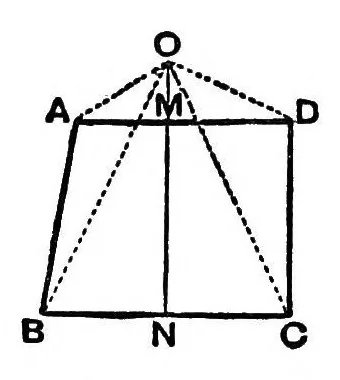
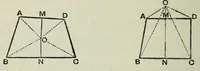
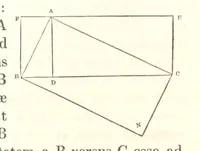
h Fallacy*. To prove that, if two opposite sides of a quadrilateral are equal, the other two sides must be parallel. Let ABCD be a quadrilateral such that AB is equal to DC. Bisect AD in M, and through M draw MO at right angles to AD. Bisect BC in N, and draw NO at right angles to BC. If MO and NO… … diagram or outside the quadrilateral as in the right-hand diagram, Join OA, OB, OC, OD. Since OY bisects AD and is perpendicular to it, we have OA = OD, and the angle OAM equal to the angle ODM. Similarly OB= OC, and the angle OBN is equal to the angle OCN. Also by hypothesis AB = DC, hence, by…