Mechanics of engineering (solids) : comprising statics and kinetics of solids, and the mechanics of the materials of construction, or strength and elasticity of beams, columns, shafts, arches, etc. : for use in technical schools (1911)
Church, Irving P. (Irving Porter), 1851-1931 · New York : Wiley ; London : Chapman & Hall · leaf 343
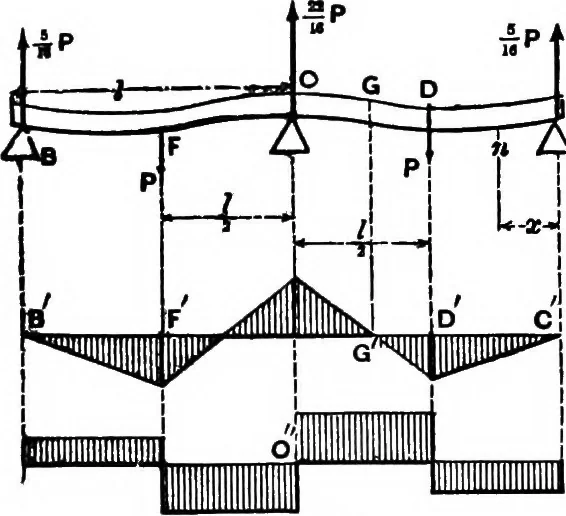
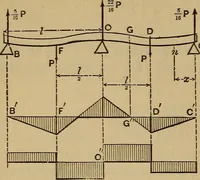
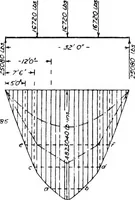
d, Pg = P^ = ^ P is independentof the material and form of the beam so long as it is ho-mogeneous and prismatic.) If Pq, which would then =^ P — 6 EI {hg-i-lF), is found to be negative, it shows that0 requires a support from above, instead of below, tocause it to occupy a position Iiq below the… … i.e., varies directly as x, un-c til X passes D when, for anypoint on DO, M=U^x-Pix-^) •which is =0, (point of in-flection of elastic curve)for x=^/u I (note that x isFia. arr. measured from C in this figure) and at 0, where x= I, becomes —^Pl .: M^^—IPI; i!fo=0; M^=^Pl; andi{f„=0 Hence, since J!f…
Mechanics, Applied · Strength of materials
Internet Archive · Cornell University Library · Public Domain Mark 1.0. Free to use for anything.