Cyclopedia of textile work : a general reference library on cotton, woolen and worsted yarn manufacture, weaving, designing, chemistry and dyeing, finishing, knitting, and allied subjects (1911)
American School (Lansing, Ill.) · Chicago : American school of correspondence · leaf 115
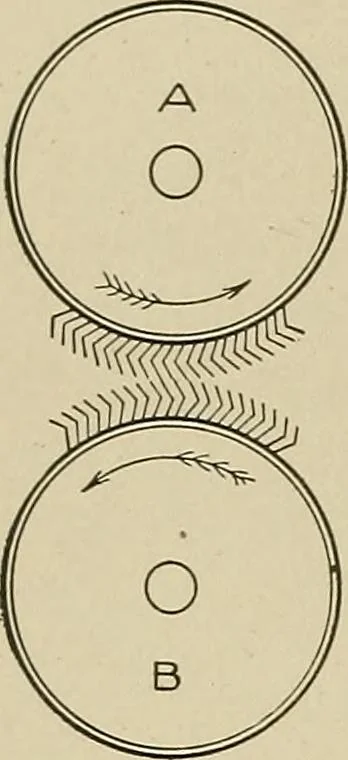
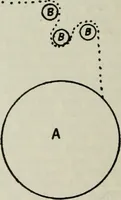
ippers proper they over-runtheir workers by thirty times their surface traverse! The actual direction in which two worker rolls revolve is notessential in the theory of carding; but in order to get any workingor combing between two rolls, the wires must be inclined point topoint, and one must move… … second, they would both be doing exactly the same amount ofcombing as if the motion of B (Fig. 53) were increased to ninetyinches per second, and A were allowed to retreat heel first at its oldspeed of thirty inches. In both cases the points of B would berunning past the points of A at sixty inches…
Textile fabrics · Textile industry
Internet Archive · UMass Dartmouth, Claire T. Carney Library · Public Domain Mark 1.0. Free to use for anything.