An elementary treatise on mechanics, embracing the theory of statics and dynamics, and its applications to solids and fluids (1849)
Smith, Augustus William, 1802-1866 · New York, Harper · leaf 57
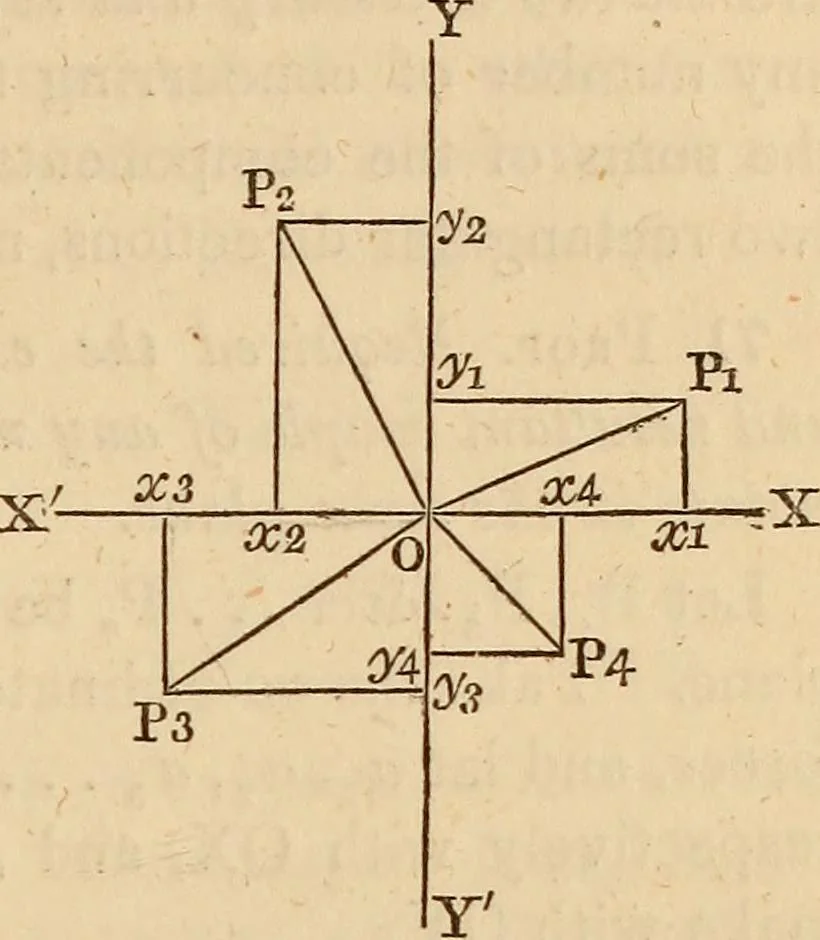
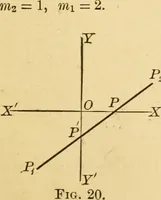
ust equal theresolved parts of the forces in the same directions. .-. R cos. 0=2.X, (3) R sin. 0=2.Y. (4) Hence Tan. 0=^. (5) Also, R2. cos.2^+R2.sin.20=R2=(S.X)2 + (S.Y)2; or R=v,(2.X)2 + (^.Y)2. (6) Equations (1) and (2) give the values of 2.X and S.Y, bywhich we obtain 0 from (5) and R from (6)… … nents along either axis are involved in the trigonometrical ex-pressions of their values, (1) and(2). Assume the directions OXand OY positive, and OX, OYnegative. The components 0^15Oyx of Px are positive ; theirvalues, Pa cos. al9 Px cos. j3,,will also be positive, since thecosines of angles in…
Mechanics, Analytic
Internet Archive · Library of Congress · Public Domain Mark 1.0. Free to use for anything.
![An illustration from [Electric engineering.] (1902)](https://img.insideoutlibrary.com/img/200/ia-electricengineer02inte-323-177.webp)