The elements of natural philosophy : copiously illustrated by familiar experiments and containing descriptions of instruments, with directions for using : designed for the use of schools and academies (1856)
Sprague, A. W. (Alfred White), 1821-1891 · Boston : Phillips, Sampson & Company · leaf 36
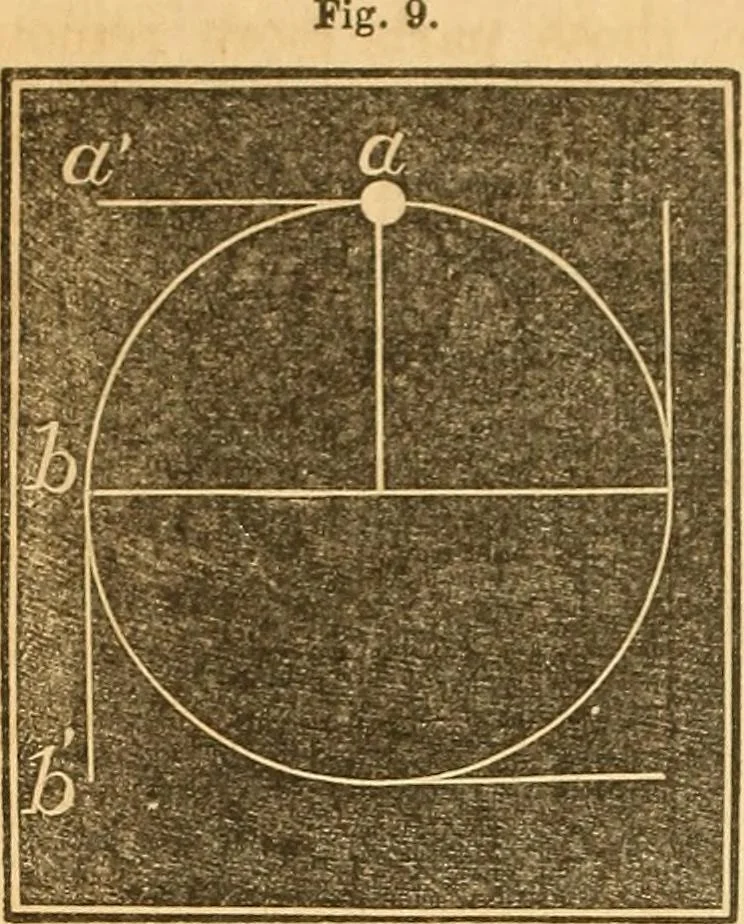
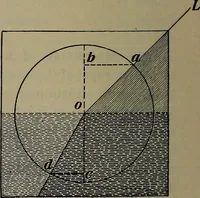
on ofa body about a fixed point: as when a ball attached to a stringis made to revolve about the finger. Owing to the inertia ofbodies causing them to persevere in straight lines, these, whenrevolving in a circle, tend constantly to recede from the centre What forces act on a body tlirown oblique… … of motion, and fly off in a tangent tothe circle. Thus, in Fig. 9, the bodya, at the points a, 6, tends to movein the direction of the tangents a a,b Z>, and so at every other point inthe circle. The force which holds a body andconfines it in its circular path, istermed the centripetal force; *…
Physics
Internet Archive · Library of Congress · Public Domain Mark 1.0. Free to use for anything.