Laurence, Lionel · London, School of Optics · leaf 258
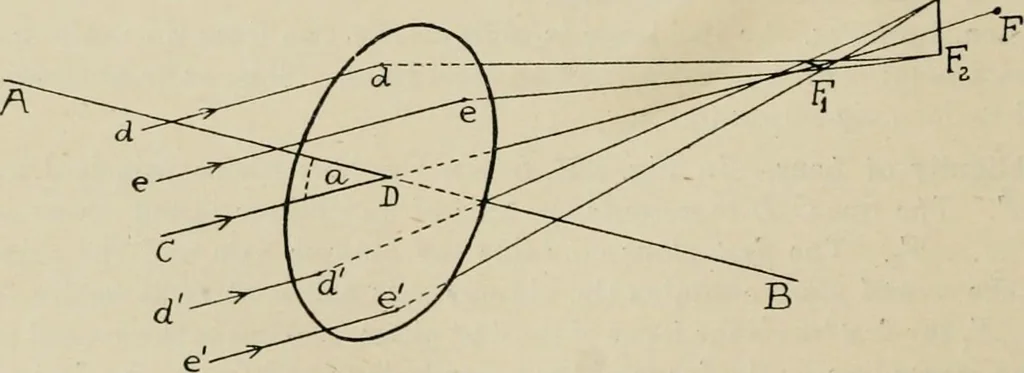
Therefraction is therefore increased in both meridians, but mostly in that at rightangles to the axis of rotation. The increased power in the meridian of the rotation is owing to the factthat the light passes through a rather greater thickness of lens when the latteris oblique than when placed… … Fig. 269. Tilted Sph.—In Fig. 269 let a be the angle of rotation of the lens, F thefocal length, and Fx and F2 the first and second oblique foci. A B is the OBLIQUE REFRACTION AND DEVIATION 217 principal axis of the lens, and C D is the secondary axial ray on which the focallines are formed. The…
Optics
Internet Archive · Gerstein Library, University of Toronto · Public Domain Mark 1.0. Free to use for anything.