An introduction to projective geometry and its applications; an analytic and synthetic treatment (1905)
Emch, Arnold, b. 1871 · New York, J. Wiley & sons; London, Chapman & Hall, limited · leaf 55
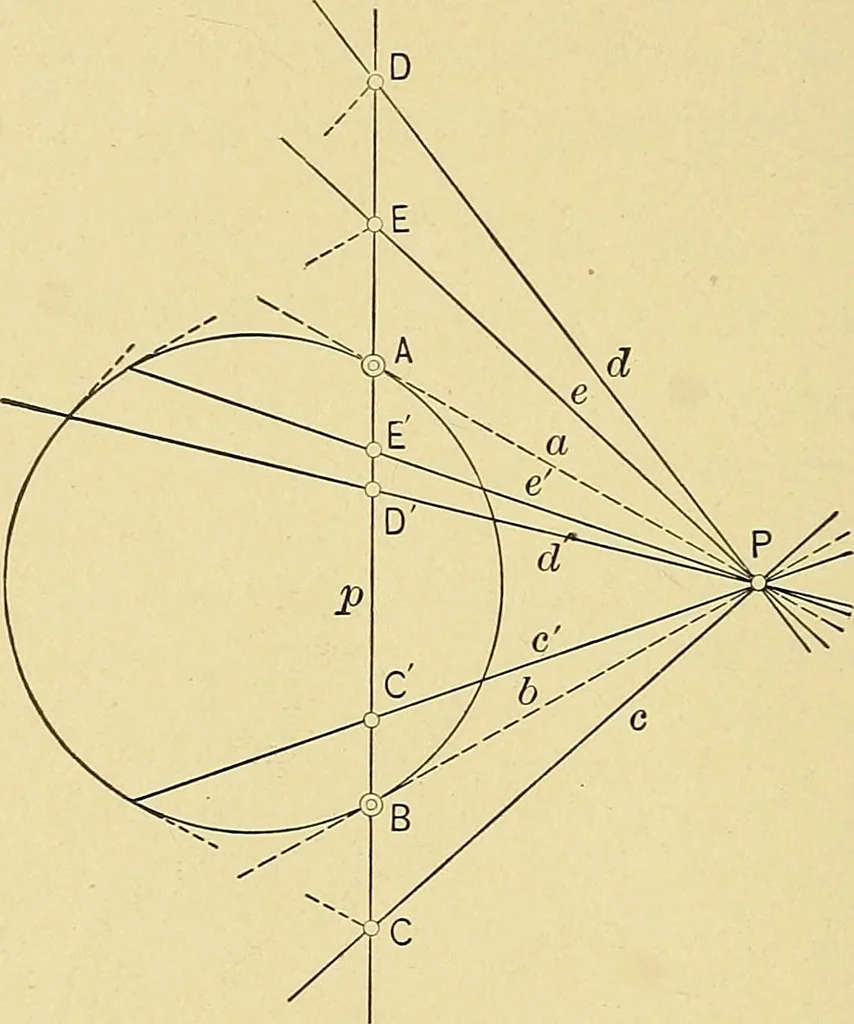
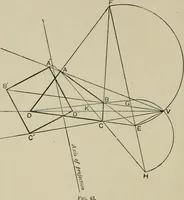
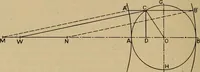
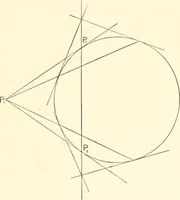
d the point of intersectionH of the lines connecting C with E, and D with F. The linethrough G and H is the required polar of A. The proof is imme-diate, for (ABCD) = (AEIF) = — i, which is the condition thatGH be the polar of A. The polar of H must pass through A,and since (HGBI) = — i, it follows… … Fig. 16. vertices is the opposite side in the triangle, and the pole of eachside is the opposite vertex of this side. This triangle is calleda self-polar triangle with regard to the circle. Consider now in Fig. 16 the pole P and its polar p inter-secting the circle in two points A and B. Through P…
Geometry, Projective · Geometry, Analytic
Internet Archive · Boston College Libraries · Public Domain Mark 1.0. Free to use for anything.