History of physical astronomy, from the earliest ages to the middle of the 19th century. Comprehending a detailed account of the establishment of the theory of gravitation by Newton, and its development by his successors; with an exposition of the progress of research on all the other subjects of celestial physics (1852)
Grant, Robert, 1814-1892 · London, R. Baldwin · leaf 616
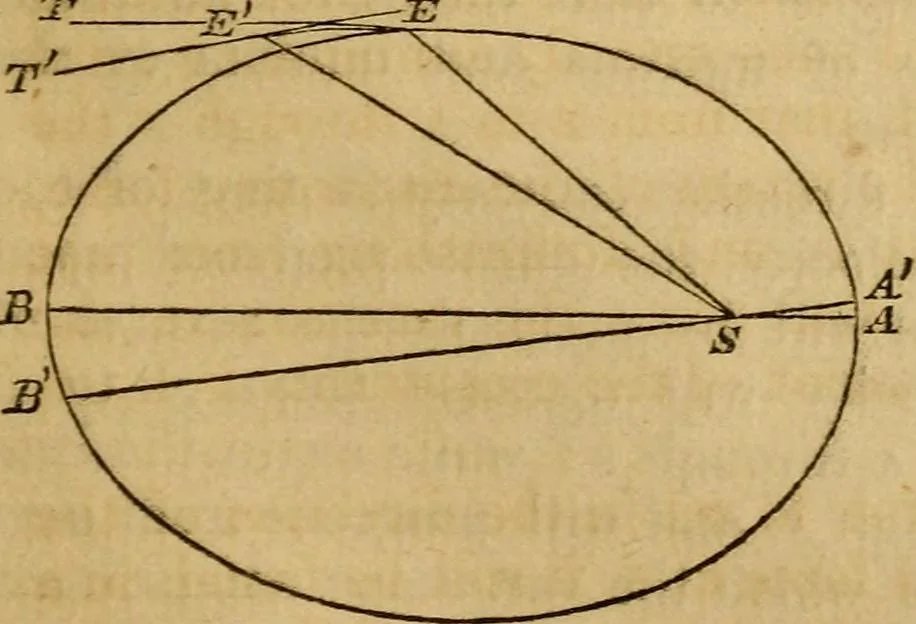
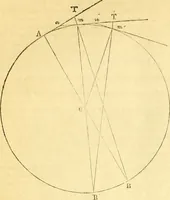
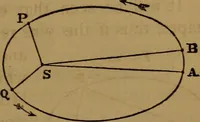
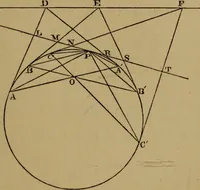
ection of motion in the undis-turbed orbit exactly compensates forthe angular displacement of the radiusvector, and the tangential angle inconsequence remains for an instantinvariable. The velocity of the planet,however, being now increased by theaction of the disturbing force, themomentary… … 59S APPENDIX. responding change of direction of the radius vector, and let e t be atangent to the orbit at that point. Then, since the angle s e t is greaterthan s E T, it follows that the eccentricity is increased by the disturbingforce. It is evident, however, that the increase of that element is…
Astronomy
Internet Archive · Wellesley College Library · Public Domain Mark 1.0. Free to use for anything.