An introduction to projective geometry and its applications; an analytic and synthetic treatment (1905)
Emch, Arnold, b. 1871 · New York, J. Wiley & sons; London, Chapman & Hall, limited · leaf 148
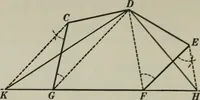
s (A =0, F = o) and(C = o, D=o). Then A-C-XB-G = o, F-D-/xEG = o are two forms in which the equation of the given conic may bewritten. From these two forms we get A-C-F-D^G(W-fxE). Now the points (A—o, D=o) and (C = o, F = o) are notsituated on the line G=o, consequently they must lie on theline… … Fig. 51. By considering A =0, etc., as the line-equations of the sixvertices of a hexagon circumscribed to a conic, Brianchon*stheorem may be deduced in a similar manner. 136 PROJECTIVE GEOMETRY. 3. Assuming as a conic a degenerate hyperbola, consistingof two intersecting lines and on each three…
Geometry, Projective · Geometry, Analytic
Internet Archive · Library of Congress · Public Domain Mark 1.0. Free to use for anything.