Ball, W. W. Rouse (Walter William Rouse), 1850-1925 · London, Macmillan and Co., limited · leaf 337
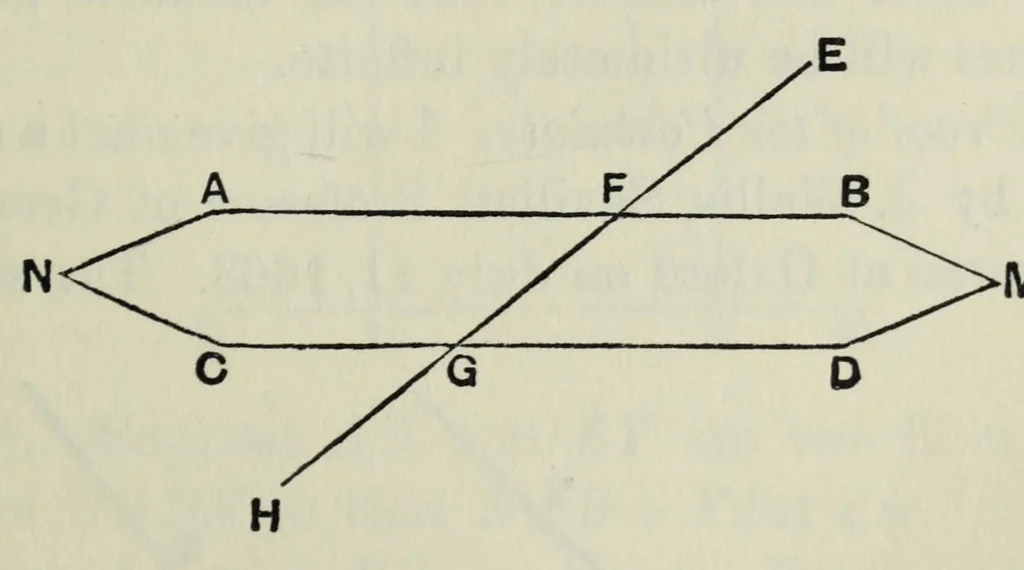
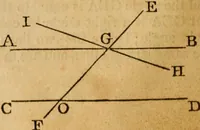
ve that AB and CD are parallel. If possible let them not be parallel, then they will meet when produced say at M (or N). But the angle AFG is the supplement of BFG and is therefore equal to FGD . Similarly the angle FGC is equal to BFG . Hence the sum of the angles AFG and FGC is equal to two right… … Conversely, if AB and CD be parallel, then A F and CG are not less parallel than FB and GD ; and therefore whatever be the sum of the angles AFG and FGC, such also must be the * Proclus, ed. G. Friedlein, Leipzig, 1873, pp. 362 — 368.
Geometry · Astrology · Space and time · Matter · Magic squares · Mathematical recreations
Internet Archive · University of Illinois Urbana-Champaign · Public domain (published before 1931). Free to use for anything.