Mechanical movements, powers and devices; a treatise describing mechanical movements and devices used in constructive and operative machinery and the mechanical arts, being practically a mechanical dictionary, commencing with a rudimentary description of the early known mechanical powers and detailing the various motions, appliances and inventions used in the mechanical arts to the present time, including a chapter on straight line movements, by Gardner D. Hiscox (1914)
Hiscox, Gardner Dexter, 1822?-1908 · New York, The Norman W. Henley publishing co. · leaf 327
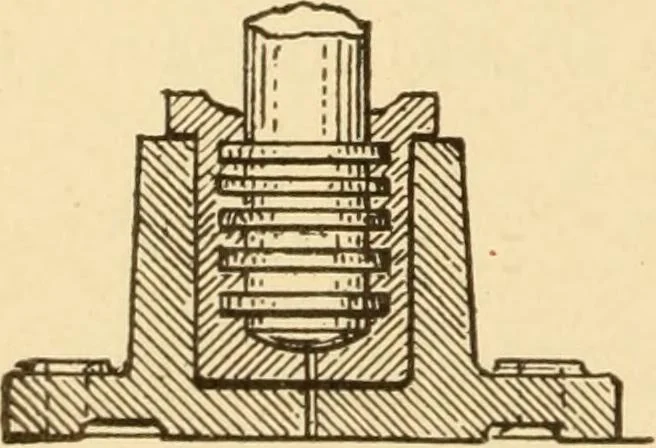
78. LUBRICATION OF A HANGINGBEARING by hydraulic pressure. Oil isforced into the grooves of the bearing throughthe small holes and discharges into the cuparound the outside. 1279. VERTICAL SHAFT STEP.—Madeadjustable by a movable bearing held by setscrews in the foot block. 1280. SHAFT STEP… … 1282. COLLAR BEARING AND STEP for a vertical shaft. The thrust sleeve ofbronze is split and should have a key to pre-vent rotation. MILL AND FACTORY APPLIANCES. 317
Mechanical movements
Internet Archive · Library of Congress · Public Domain Mark 1.0. Free to use for anything.
![An illustration from [Electric engineering.] (1902)](https://img.insideoutlibrary.com/img/200/ia-electricengineer03inte-639-381.webp)