Mechanical movements, powers and devices; a treatise describing mechanical movements and devices used in constructive and operative machinery and the mechanical arts, being practically a mechanical dictionary, commencing with a rudimentary description of the early known mechanical powers and detailing the various motions, appliances and inventions used in the mechanical arts to the present time, including a chapter on straight line movements, by Gardner D. Hiscox (1914)
Hiscox, Gardner Dexter, 1822?-1908 · New York, The Norman W. Henley publishing co. · leaf 344
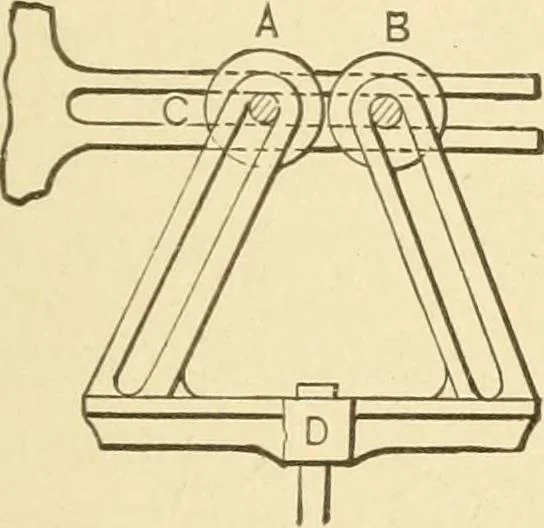
felted edge closes the top ofthe pan. The friction stopC acts as a brake to stopiz2g the motion of the pan. … 1376. CLOSURE OF ROLLERS by tra-versing the angular slots guiding the rollerbearings. The slot guide C is fixed. Thepiston-rod head D carries the angular slotsthat move the rollers forward and backward. 1377. VIBRATING LIFT.—The revolving druirB lifts the weight W, while the crank-pin connectingrod…
Mechanical movements
Internet Archive · Library of Congress · Public Domain Mark 1.0. Free to use for anything.
![An illustration from [Electric engineering.] (1902)](https://img.insideoutlibrary.com/img/200/ia-electricengineer02inte-137-52.webp)