The practical astronomer : comprising illustrations of light and colours, practical descriptions of all kinds of telescopes, the use of the equatorial-transit, circular, and other astronomical instruments, a particular account of the Earl of Rosse's large telescopes, and other topics connected with astronomy (1845)
Dick, Thomas, 1774-1857 · London : Seeley, Burnside, and Seeley · leaf 94
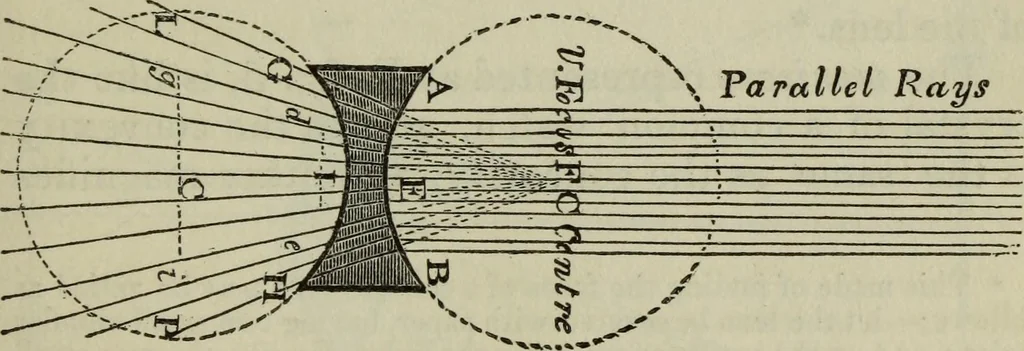
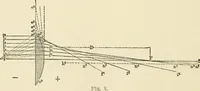
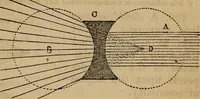
so, and convergent raysare made less convergent. Hence objects seenthrough concave glasses appear considerably smallerand more distant than they really are. The fol-lowing diagram, fig. 12, represents the course ofparallel rays through a double concave lens, wherethe parallel rays T A, D E, IB,… … The principal focal distance E F, is the same asin convex lenses. Concave glasses are used tocorrect the imperfect vision of short-sighted per- 70 THE PRACTICAL ASTRONOMER. sons. As the form of the eye of such persons istoo convex, the rays are made to converge beforethey reach the optic nerve; and…
Astronomy · Astronomical instruments · Telescopes
Internet Archive · Getty Research Institute · Public Domain Mark 1.0. Free to use for anything.