Appletons' cyclopaedia of applied mechanics: a dictionary of mechanical engineering and the mechanical arts (1880)
D. Appleton and Company, Benjamin, Park, 1849-1922 · New York, D. Appleton · leaf 959
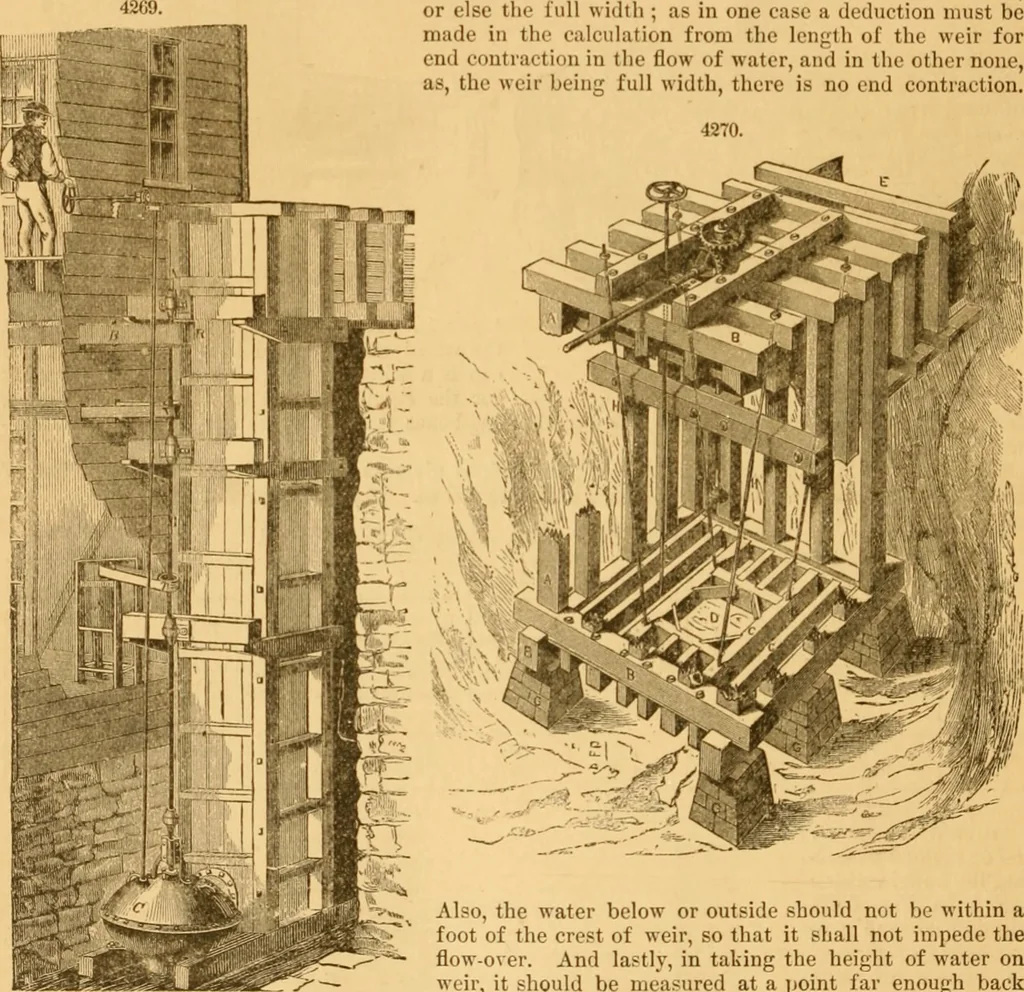
onlycome in contact with sharp up-stream edges; then, from the bottom of the race to the top or crest ofweir, the height must be at least three times the depth of water that will flow over. A weir one foot deep should be two feet shortei than the width of tail-race,or else the full width ; as in… … Also, the water below or outside should not be within afoot of the crest of weir, so that it shall not impede theflow-over. And lastly, in taking the height of water onweir, it should be measured at a point far enough backor up stream to be above the curvature of the surfaceoccasioned by the fall…
Mechanical engineering -- Dictionaries
Internet Archive · Boston Library Consortium · Public Domain Mark 1.0. Free to use for anything.