The Cambridge course of elementary natural philosophy; being the demonstrations of the propositions in mechanics and hydrostatics in which those persons who are not candidates for honours are examined for the degree of B.A (1844)
Snowball, John Charles, d. 1855 · Cambridge [Eng.] T. Stevenson; [etc., etc.] · leaf 31
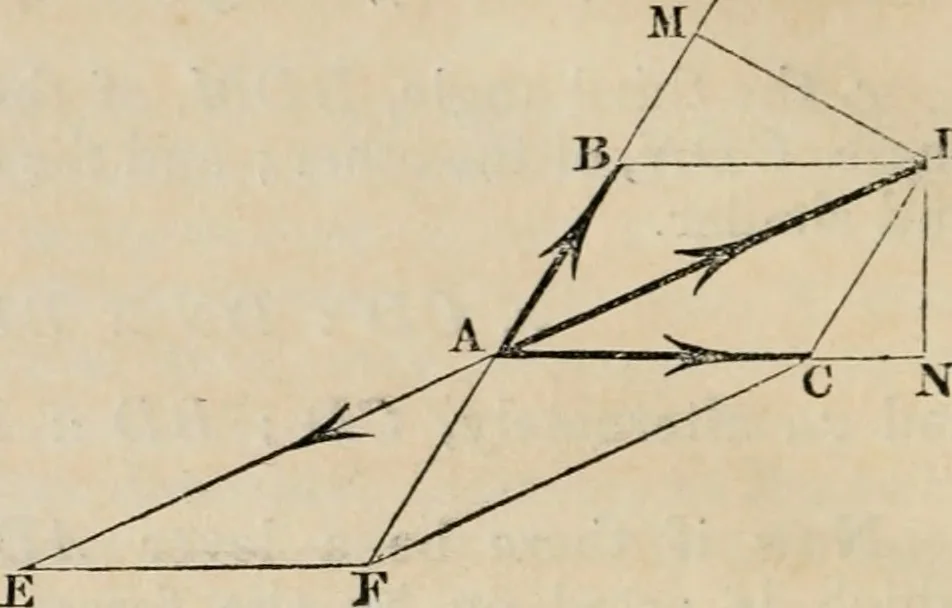
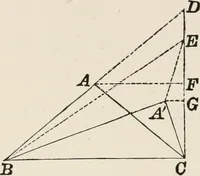
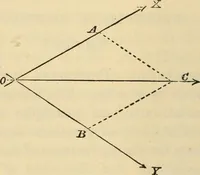
he diagonal represents it in magnitude as well asin direction. Produce DA, and suppose a force AE to be taken init equal and opposite to the Resultant of AB and AC.The joint effect of AB and AC will now be counteractedby AE; and the point A, which is acted on by the threeforces AB, AC, and AE, will… … Complete the parallelogram EC, and draw the diagonalAF. By the first part ofthe Proposition, ^.Fistheline in which the result-ant of AE and A C acts ;and since the force ABis equal and opposite tothat resultant, AF mustbe in the same straightline with AB, and, there-fore, it is parallel toCD.…
Statics · Hydrostatics
Internet Archive · California Digital Library · Public Domain Mark 1.0. Free to use for anything.