The microscopy of vegetable foods : with special reference to the detection of adulteration and the diagnosis of mixtures (1906)
Winton, Andrew Lincoln, 1864-1946, Moeller, Josef, 1848-1924 · New York : John Wiley & Sons · leaf 201
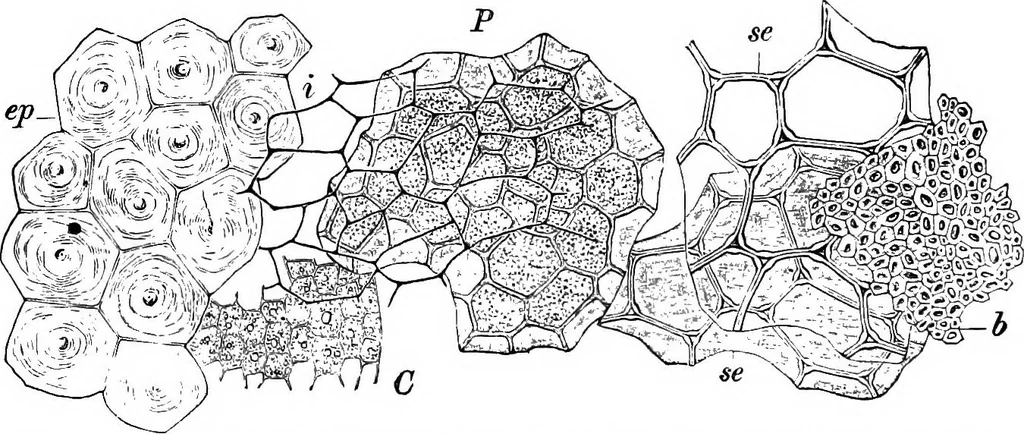
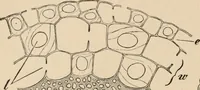
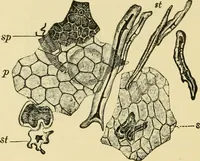
layers. 3. Palisade Cells (&). Radially elongated cells thickened in the innerhalves form the most conspicuous layer of the seed, the thickened wallsforming a kind of cup, hence the name beaker cells. Of great diagnosticimportance are the colorless, thickened walls, which in most… … Fig. 145. White Mustard. Elements of seed in surface view, ep epidermis, se collen-chyma, b palisade cells, and p parenchyma, of spermoderm; P aleurone cells of endo-sperm; C cotyledon tissue. (MoELLER.) 4. Inner Layers {p). Two or more layers of thin-walled isodiametricor elongated cells complete…
Plant anatomy · Food adulteration and inspection · Microscopy
Internet Archive · Cornell University Library · Public Domain Mark 1.0. Free to use for anything.