The practical astronomer : comprising illustrations of light and colours, practical descriptions of all kinds of telescopes, the use of the equatorial-transit, circular, and other astronomical instruments, a particular account of the Earl of Rosse's large telescopes, and other topics connected with astronomy (1845)
Dick, Thomas, 1774-1857 · London : Seeley, Burnside, and Seeley · leaf 172
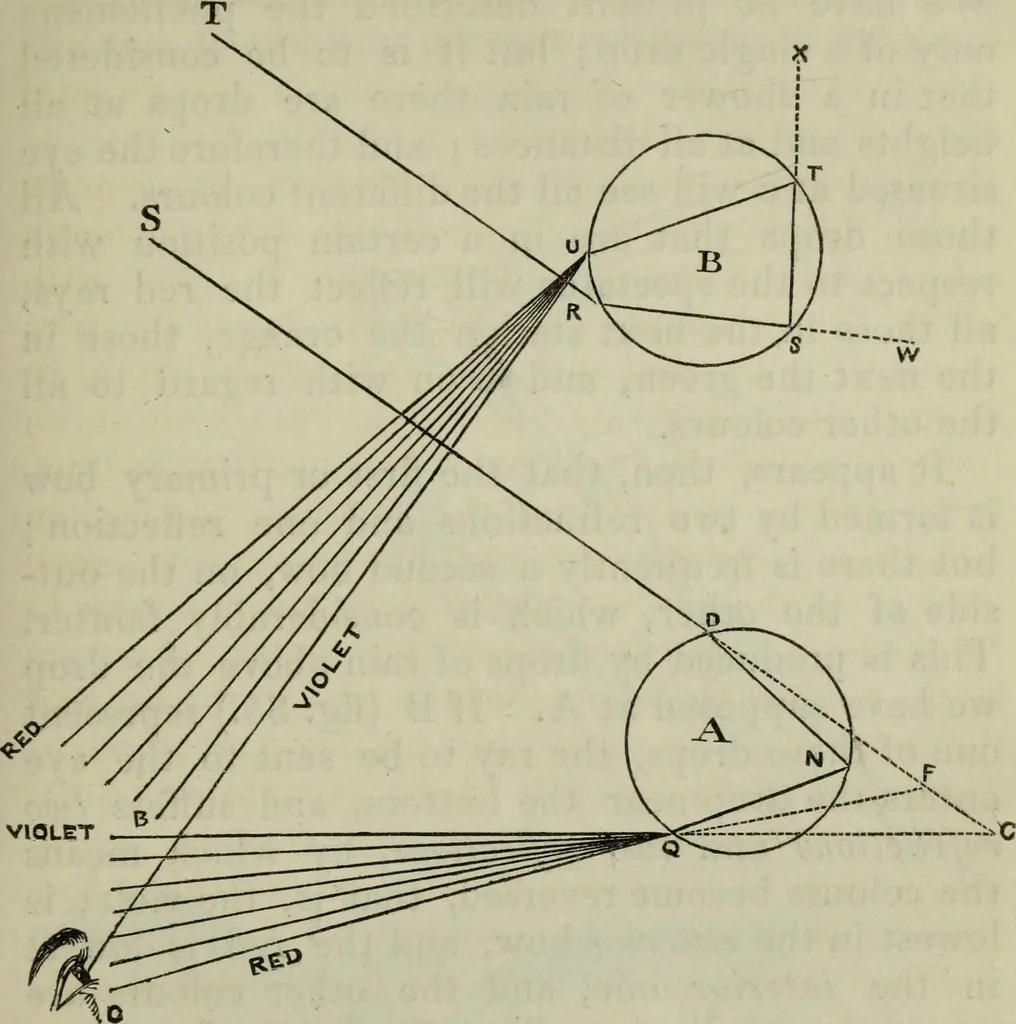
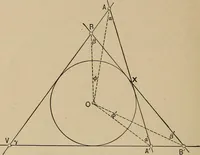
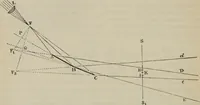
d to q—some part of it will, of course, pass through thedrop. By the obliquity with which it falls on theside of the drop at q, that part becomes a kind ofprisms, and separates the ray into its primitivecolours. It is found by computation that, after aray has suffered two refractions and one… … violet, or greatest refrangible ray will make withthe solar ray, an angle of 40° 17, as Scq; andthus all the particles of water within the differenceof those two angles, namely 1° 45—(supposingthe ray to proceed merely from the centre of thesun)—willexhibit severally the coloursof the prism,and…
Astronomy · Astronomical instruments · Telescopes
Internet Archive · Getty Research Institute · Public Domain Mark 1.0. Free to use for anything.