The theory and practice of modern framed structures : designed for the use of schools, and for engineers in professional practice (1897)
Johnson, J. B. (John Butler), 1850-1902, Bryan, C. W. (Charles Walter), 1863-1927, Turneaure, Frederick Eugene, 1886- · New York : J. Wiley & Sons · leaf 408
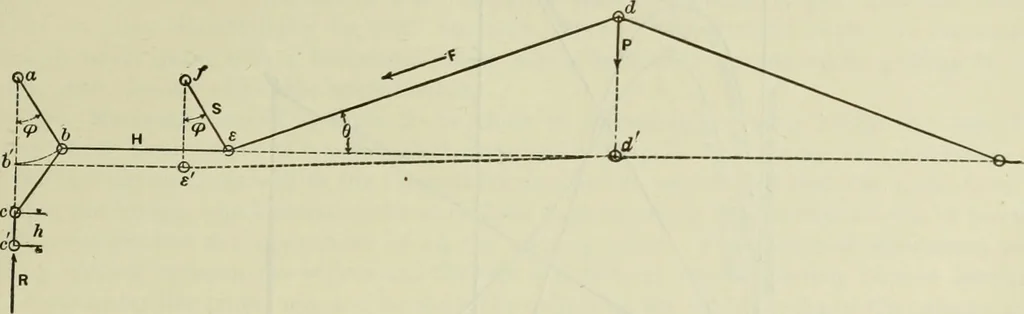
re of the bridge. As thescrews turn, the nuts N, called the cam nuts, travel in guides, up or down, on the screws,which action shortens or lengthens the toggle-joints, and at the same time lowers or raises theends of the bridge. In Fig. 400, let R represent the end reaction, which equals the load… … Fig. 400. the arms fe and ed. The distance dd represents the travel of the cam nut, which receives athrust =: P from the screw. Let F represent the thrust in the arm ed from the cam nut at d; then we have F — — cosec Q,2 p S = - sec <p*2 H = F cos ^ + .S sin 0; .♦. H = -(cot 0 4- tan 0). But //=…